Ace - AI Tutor
Ask Our Educators
Textbooks
My Library
Flashcards
Scribe - AI Notes
Notes & Exams
Download App
Asser Assgid

Asser A.

Divider

Questions asked

ANSWERED

A graphing calculator is recommended. If a ball is thrown into the air with an initial velocity of 52 ft/s, its height in feet after t seconds is given by y = 52t - 16t^2. (a) Find the average velocity of the ball (in ft/s) for the time interval beginning at t = 2 and lasting for each of the following. (i) 0.5 seconds ft/s (ii) 0.1 seconds ft/s (iii) 0.05 seconds ft/s (iv) 0.01 seconds ft/s (b) Use your answers from part (a) to estimate the instantaneous velocity (in ft/s) when t = 2. ft/s

View Answer
divider
ANSWERED

The point ( P(5,-3) ) lies on the curve ( y=frac{3}{4-x} ). (a) If ( Q ) is the point ( left(x, frac{3}{4-x} ight) ), find the slope of the secant line ( P Q ) (correct to six decimal places) for the following values of ( x ). (i) 4.9 ( m_{P Q}= ) (ii) 4.99 ( m_{P Q}= ) (iii) 4.999 ( m_{P Q}= ) (iv) 4.9999 ( m_{P Q}= ) (v) 5.1 ( m_{P Q}= ) (vi) 5.01 ( m_{P Q}= ) (vii) 5.001 ( m_{P Q}= ) (viii) 5.0001 ( m_{P Q}= ) (b) Using the results of part (a), guess the value of the slope of the tangent line to the curve at ( P(5,-3) ). ( m= )

View Answer
divider
ANSWERED

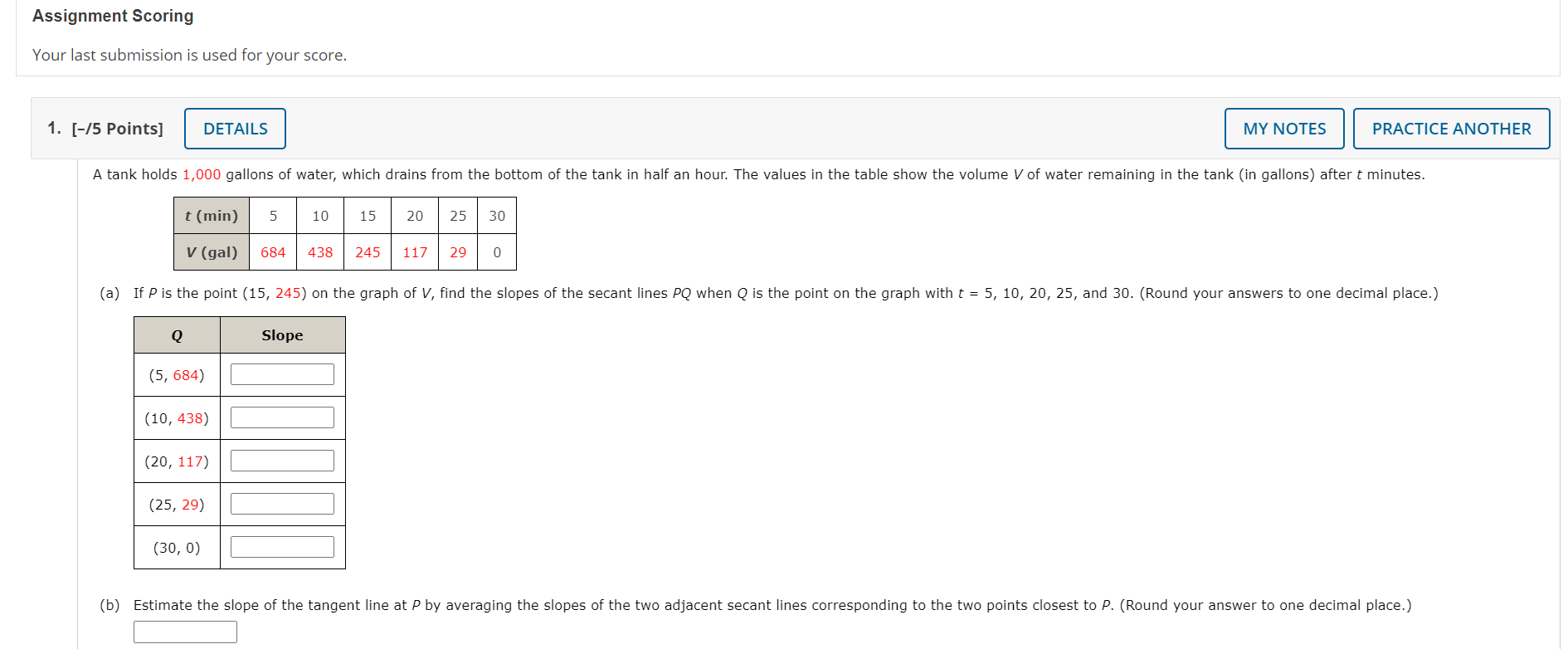
A tank holds 1,000 gallons of water, which drains from the bottom of the tank in half an hour. The values in the table show the volume V of water remaining in the tank (in gallons) after t minutes. t (min) | 5 | 10 | 15 | 20 | 25 | 30 V (gal) | 684 | 438 | 245 | 117 | 29 | 0 (a) If P is the point (15, 245) on the graph of V, find the slopes of the secant lines PQ when Q is the point on the graph with t = 5, 10, 20, 25, and 30. (Round your answers to one decimal place.) Q | Slope (5, 684) | (10, 438) | (20, 117) | (25, 29) | (30, 0) | (b) Estimate the slope of the tangent line at P by averaging the slopes of the two adjacent secant lines corresponding to the two points closest to P. (Round your answer to one decimal place.)
View Answer
divider
ANSWERED

The drawing shows three objects. They are connected by strings that pass over massless and friction-free pulleys. The objects move starting from rest, and the coefficient of kinetic friction between the middle object and the surface of the table is 0.118. (a) What is the acceleration of the three objects? (b) Find the tension in the string attached to the 25.0 kg object. (c) Find the tension in the string attached to the 10.0 kg object.

View Answer
divider
ANSWERED

A 1.40-kg bottle of vintage wine is lying horizontally in a rack, as shown in the drawing. The two surfaces on which the bottle rests are 90.0° apart, and the right surface makes an angle of 45.0° with respect to the horizontal. Each surface exerts a force on the bottle that is perpendicular to the surface. Both forces have the same magnitude F. Find the value of F. Assume g = 9.81 m/s2.

View Answer
divider
ANSWERED

The drawing (not to scale) shows one alignment of the sun, earth, and moon. The gravitational force that the sun exerts on the moon is perpendicular to the force that the earth exerts on the moon. The masses are: mass of sun=1.99 × 1030 kg, mass of earth=5.98 × 1024 kg, mass of moon=7.35 × 10²² kg. The distances shown in the drawing are rSM = 1.50 × 10¹¹ m and rEM = 3.85 × 10⁸ m. Determine the magnitude of the net gravitational force on the moon.

View Answer
divider
ANSWERED

A 212-kg log is pulled up a ramp by means of a rope that is parallel to the surface of the ramp. The ramp is inclined at 34.7° with respect to the horizontal. The coefficient of kinetic friction between the log and the ramp is 0.781, and the log has an acceleration of 0.776 m/s2. Find the tension in the rope.

View Answer
divider
ANSWERED

In the drawing, the rope and the pulleys are massless, and there is no friction. Find (a) the tension in the rope and (b) the acceleration of the 10.0-kg block. (Hint: The larger mass moves twice as far as the smaller mass.)

View Answer
divider
ANSWERED

The drawing shows three objects. They are connected by strings that pass over massless and friction-free pulleys. The objects move starting from rest, and the coefficient of kinetic friction between the middle object and the surface of the table is 0.118. (a) What is the acceleration of the three objects? (b) Find the tension in the string attached to the 25.0 kg object. (c) Find the tension in the string attached to the 10.0 kg object.

View Answer
divider
ANSWERED

The drawing shows three objects. They are connected by strings that pass over massless and friction-free pulleys. The objects move starting from rest, and the coefficient of kinetic friction between the middle object and the surface of the table is 0.118. (a) What is the acceleration of the three objects? (b) Find the tension in the string attached to the 25.0 kg object. (c) Find the tension in the string attached to the 10.0 kg object.

View Answer
divider