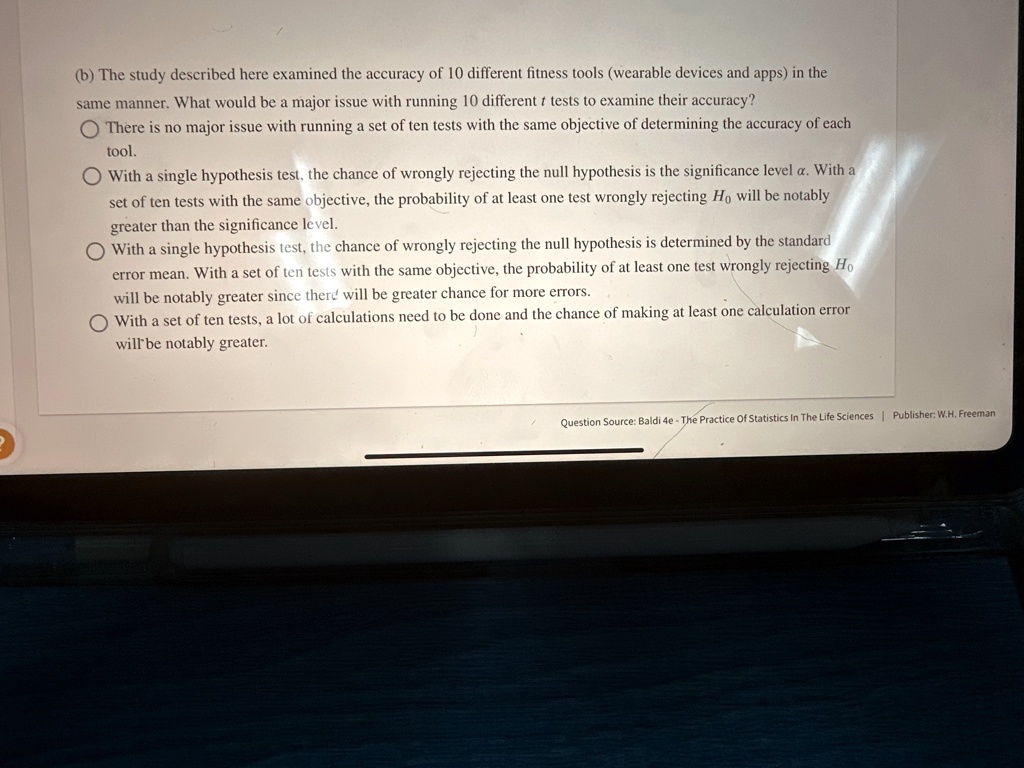
(b) The study described here examined the accuracy of 10 different fitness tools (wearable devices and apps) in the same manner. What would be a major issue with running 10 different \( t \) tests to examine their accuracy?There is no major issue with running a set of ten tests with the same objective of determining the accuracy of each tool.With a single hypothesis test, the chance of wrongly rejecting the null hypothesis is the significance level \( \alpha \). With a set of ten tests with the same objective, the probability of at least one test wrongly rejecting \( H_{0} \) will be notably greater than the significance level.With a single hypothesis test, the chance of wrongly rejecting the null hypothesis is determined by the standard error mean. With a set of ten tests with the same objective, the probability of at least one test wrongly rejecting \( H_{0} \) will be notably greater since there will be greater chance for more errors.With a set of ten tests, a lot of calculations need to be done and the chance of making at least one calculation error will'be notably greater.