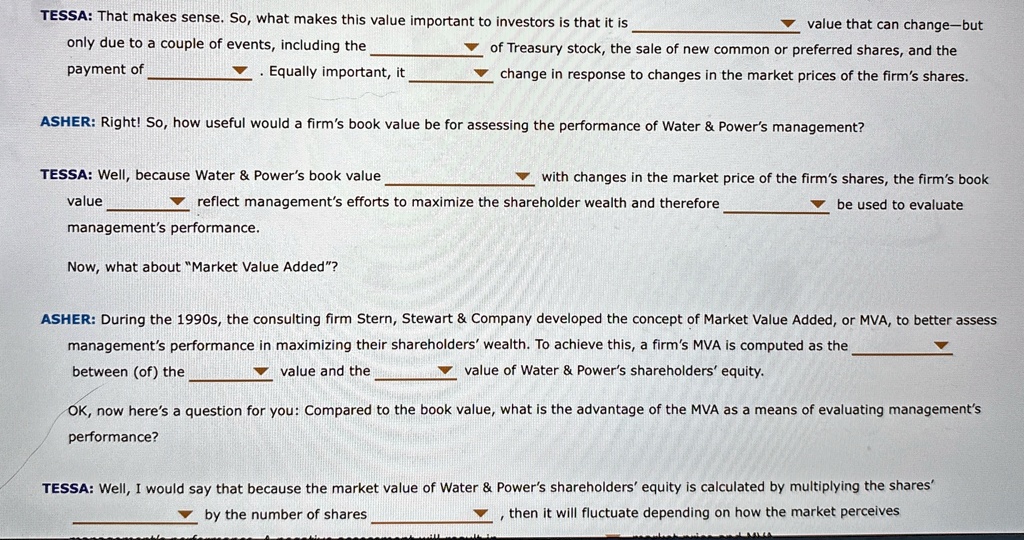
TESSA: That makes sense. So, what makes this value important to investors is that it is ◻ value that can change-but only due to a couple of events, including the ◻ of Treasury stock, the sale of new common or preferred shares, and the payment of ◻ _. Equally important, it change in response to changes in the market prices of the firm's shares.
ASHER: Right! So, how useful would a firm's book value be for assessing the performance of Water & Power's management?
TESSA: Well, because Water & Power's book value ◻ - with changes in the market price of the firm's shares, the firm's book value ◻ reflect management's efforts to maximize the shareholder wealth and therefore ◻ be used to evaluate management's performance.
Now, what about "Market Value Added"?
ASHER: During the 1990 s, the consulting firm Stern, Stewart & Company developed the concept of Market Value Added, or MVA, to better assess management's performance in maximizing their shareholders' wealth. To achieve this, a firm's MVA is computed as the between (of) the ◻ value and the ◻ value of Water & Power's shareholders' equity.
OK, now here's a question for you: Compared to the book value, what is the advantage of the MVA as a means of evaluating management's performance?
TESSA: Well, I would say that because the market value of Water & Power's shareholders' equity is calculated by multiplying the shares'
◻ by the number of shares ◻ . , then it will fluctuate depending on how the market perceives