Examine the optical micrographs of all 8 etched specimens collected from the Lab
(both steels and each heat-treating condition). Do a rough sketch of each
microstructure that clearly labels ALL the phases, constituents or defects that are
visibly present. You may have to use your hardness values, CCT diagrams and
literature to assist you in making the determination of the present phases.
For many applications, water quenched steels are not used without a further heat
treatment. Briefly explain why and what the main purpose of a further heat treatment
would be.
Explain the difference in microstructure between the different cooling rates and the
two steels - use reference to continuous cooling transformation curves in your
answer. Assume that the oil quench cooling rate is between 50-100deg (C)/(sec) and that
the water quench rate is ∼300deg (C)/(sec); You can use the pyrometer vs time data for
your air quench rate.
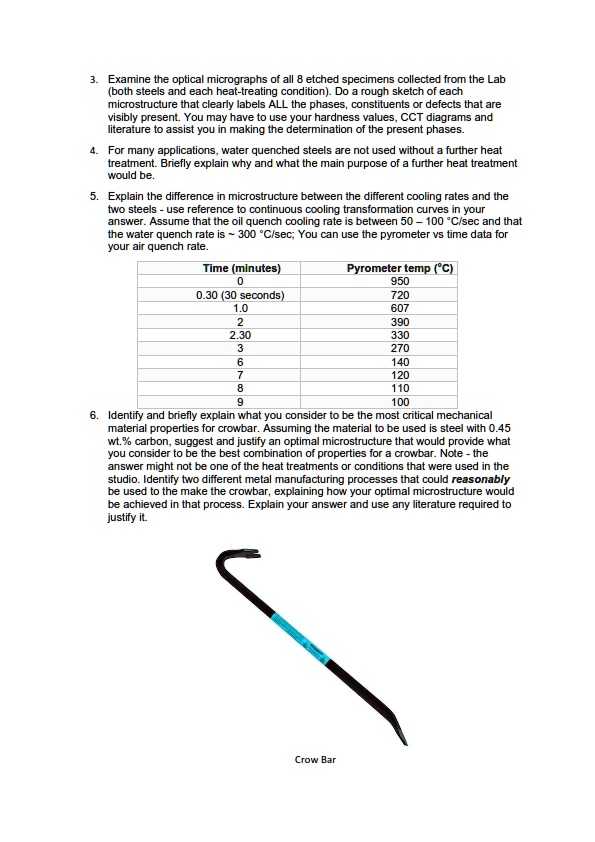
Identify and briefly explain what you consider to be the most critical mechanical
material properties for crowbar. Assuming the material to be used is steel with 0.45
wt. % carbon, suggest and justify an optimal microstructure that would provide what
you consider to be the best combination of properties for a crowbar. Note - the
answer might not be one of the heat treatments or conditions that were used in the
studio. Identify two different metal manufacturing processes that could reasonably
be used to the make the crowbar, explaining how your optimal microstructure would
be achieved in that process. Explain your answer and use any literature required to
justify it.
3. Examine the optical micrographs of all 8 etched specimens collected from the Lab (both steels and each heat-treating condition). Do a rough sketch of each microstructure that clearly labels ALL the phases, constituents or defects that are visibly present. You may have to use your hardness values, CCT diagrams and literature to assist you in making the determination of the present phases. For many applications, water quenched steels are not used without a further heat treatment. Briefly explain why and what the main purpose of a further heat treatment would be.
5. Explain the difference in microstructure between the different cooling rates and the two steels - use reference to continuous cooling transformation curves in your answer. Assume that the oil quench cooling rate is between 50 100 C/sec and that the water quench rate is ~ 300 C/sec; You can use the pyrometer vs time data for your air quench rate
Time (minutes) 0 0.30 (30 seconds) 1.0 2 2.30 3 6 7 8 6
Pyrometer temp (C) 950 720 607 390 330 270 140 120 110 100
6. Identify and briefly explain what you consider to be the most critical mechanical material properties for crowbar. Assuming the material to be used is steel with 0.45 wt.% carbon, suggest and justify an optimal microstructure that would provide what you consider to be the best combination of properties for a crowbar. Note - the answer might not be one of the heat treatments or conditions that were used in the studio. Identify two different metal manufacturing processes that could reasonably be used to the make the crowbar, explaining how your optimal microstructure would
justify it.
Crow Bar