Ace - AI Tutor
Ask Our Educators
Textbooks
My Library
Flashcards
Scribe - AI Notes
Notes & Exams
Download App
audrey ballard

audrey b.

Divider

Questions asked

BEST MATCH

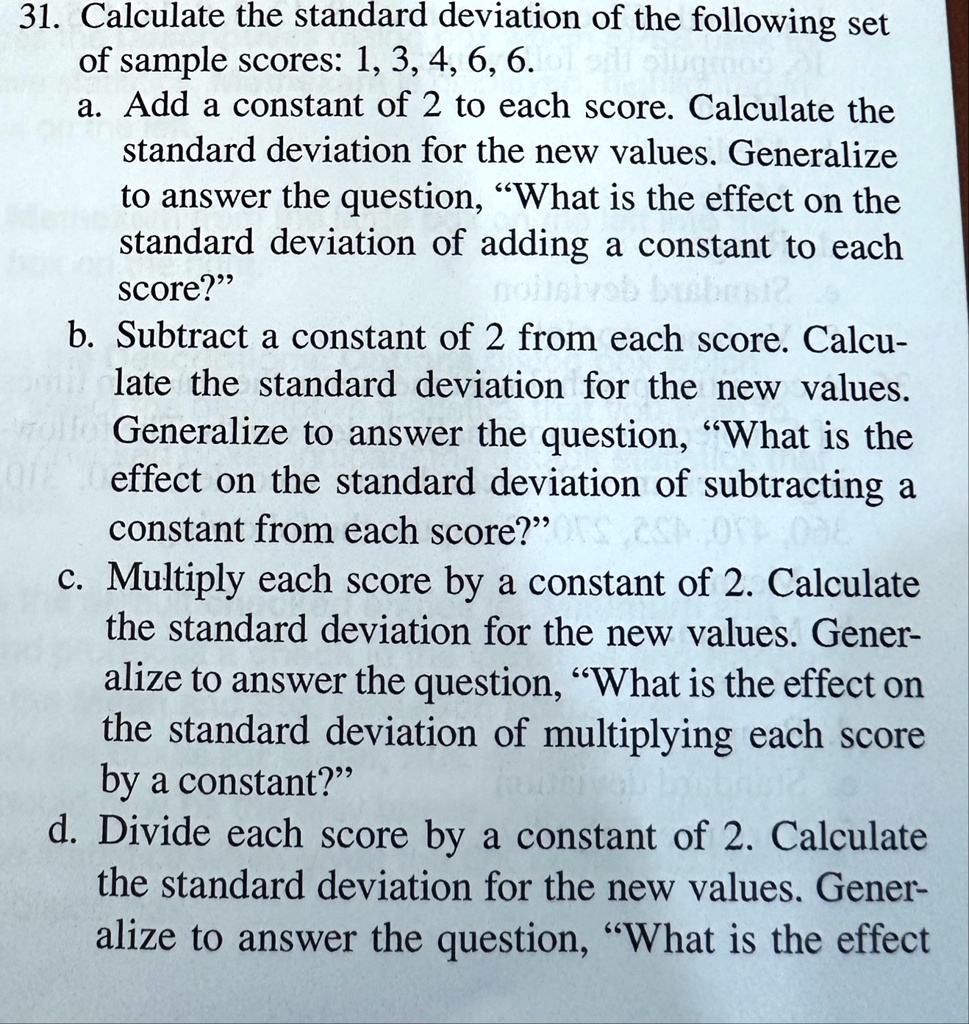
Calculate the standard deviation of the following set of sample scores: 1,3,4,6,6. a. Add a constant of 2 to each score. Calculate the standard deviation for the new values. Generalize to answer the question, "What is the effect on the standard deviation of adding a constant to each score?" b. Subtract a constant of 2 from each score. Calculate the standard deviation for the new values. Generalize to answer the question, "What is the effect on the standard deviation of subtracting a constant from each score?" c. Multiply each score by a constant of 2. Calculate the standard deviation for the new values. Generalize to answer the question, "What is the effect on the standard deviation of multiplying each score by a constant?" d. Divide each score by a constant of 2. Calculate the standard deviation for the new values. Generalize to answer the question, "What is the effect on the standard deviation of dividing each score by the constant"
View Answer
divider
BEST MATCH

_____ provide analysis and prepare reports and financial statements for their organization. Group of answer choices Public accountants Management accountants Government accountants Forensic accountants

View Answer
divider
BEST MATCH

Roles for folate in the body include: Multiple select question. the metabolism of leucine. the metabolism of methionine. red blood cell production. DNA synthesis.

View Answer
divider
BEST MATCH

an aging system that has been the source of multiple complaints. the system initiates post but then halts, displaying a "cmos configuration mismatch" error. what is the most probable reason for this error?

View Answer
divider
BEST MATCH

What is the voltage \"V$_i$\" in the figure below, given: V$_{src}$ = 11 volts R1 = 26 ohm R2 = 5 ohm R3 = 10 ohm R4 = 20 ohm R5 = 20 ohm V1 = volts Note: Enter numbers only

View Answer
divider
BEST MATCH

A particle passes through a mass spectrometer as illustrated in the figure below. The electric field between the plates of the velocity selector has a magnitude of 7830 V/m, and the magnetic fields in both the velocity selector and the deflection chamber have magnitudes of 0.0907 T. In the deflection chamber the particle strikes a photographic plate 58.0 cm removed from its exit point after traveling in a semicircle. (a) What is the mass-to-charge ratio of the particle? (b) What is the mass of the particle if it is doubly ionized? (c) What is its identity, assuming it's an element? (Enter the name of an element.)

View Answer
divider
BEST MATCH

Find the volume of the solid that results from rotating the region bounded by the graphs of $y = \frac{x^{14}}{128}$, $y = x^7$, $x = 0$, and $x = 2$ about the line $x = -4$. Write the exact answer. Do not round.

View Answer
divider
BEST MATCH

Armature Load Voltage V(s) K Torque 1(s) Velocity S Ls + R Js+h V(s) K Back emf S Angle S moment of inertia of the rotor damping (friction) of the mechanical system (back-electromotive force constant electric resistance electric inductance J=0.01 kg\cdot m^2 b=0.1 Nms K=0.01 Nm/A R=1 \Omega L=0.5 H

View Answer
divider
BEST MATCH

Question 2 2.1. Evaluate the following integral provide all details: $\int \frac{x}{\sqrt{1 - x^4}} dx$. 2.2.If $f(x) = \int_0^{g(x)} \frac{1}{\sqrt{1 + t^2}} dt$ where $g(x) = \int_0^{\cos x} [1 + \sin t^2]dt$, find $f'(\frac{\pi}{2})$ 2.3. Determine whether the integral is convergent or divergent, and evaluate it if it is convergent: $\int_{-1}^1 \frac{dx}{1 - x^2 - 2x}$ Page 1 of 3 University of Namibia Calculus II MAT 3612 Assignment 1 [100 marks] July 2022 Question 3 3.1. Find the sum of the series $\sum_{n=1}^{\infty} [\tan^{-1}(n + 1) - \tan^{-1} n]$ 3.2. Find the radius of convergence of the series $\sum_{n=1}^{\infty} \frac{(2n)!}{(n!)^2} x^n$. 3.3. Find the sum of the series: $1 - e + \frac{e^2}{2!} - \frac{e^3}{3!} + \frac{e^4}{4!} - ...$ 3.4. Determine whether the series is absolutely convergent, conditionally convergent or divergent: $\sum_{n=1}^{\infty} (-1)^n \left(\tan(\frac{1}{n})\right)^n$ 3.5. Determine whether the series is convergent or divergent $\sum_{n=1}^{\infty} \frac{(-5)^{2n}}{n^2 9^n}$

View Answer
divider
BEST MATCH

can someone please help me come up with a research topic on one of the sensory processes sight , touch , hearing, smell, or taste for example ,the effect of ___ on ____

View Answer
divider