Ace - AI Tutor
Ask Our Educators
Textbooks
My Library
Flashcards
Scribe - AI Notes
Notes & Exams
Download App
audrey merritt

audrey m.

Divider

Questions asked

BEST MATCH

Which of the following is a stress hormone released by the pituitary gland? A Leptin B Cortisol C Epinephrine D Oxytocin

View Answer
divider
BEST MATCH

Propose an efficient synthesis for the following transformation: The transformation above can be performed with some reagent or combination of the reagents listed below. Give the necessary reagent(s) in the correct order, as a string of letters (without spaces or punctuation, such as "EBF"). If there is more than one correct solution, provide just one answer. A t-BUOK B Hâ‚‚ Pt C Na2Cr2O7, H2SO4. Hâ‚‚O D MeONa E Hâ‚‚, Lindlar's cat. F 1) O: 2) DMS G TsCl. py H dilute Hâ‚‚SO4 J K L 1) LiAlH4: 2) Hâ‚‚O DMP or PCC Br 1) BH THF. 2) HONOH

View Answer
divider
BEST MATCH

Problem 3: A batch of 50 smartphones contains 8 defective ones. A customer randomly selects 5 smartphones from this batch. - What is the probability that at least 2 of the selected smartphones are defective? - What is the expected number of defective smartphones in the sample? - What is the variance of the number of defective smartphones in the sample?

View Answer
divider
BEST MATCH

Q4 1.75 Points Of the following expressions, select all that are defined. Assume all vectors have 3 components so that the cross products and dot products are defined. $(\vec{a} \cdot \vec{b}) \times \vec{c}$ $(\vec{a} \times \vec{b}) \cdot \vec{c}$ $\vec{a} (\vec{b} \cdot \vec{c})$ None of the above are defined. $\vec{a} \cdot \vec{b} + 10$ $\vec{a} \times \vec{b} + 10\vec{c}$ $(\vec{a} \times \vec{b})\vec{c}$

View Answer
divider
BEST MATCH

Given that $y = e^{\tan^{-1}x}$, where $\tan^{-1}x$ denotes the principal value, show that $(1 + x^2)\frac{dy}{dx} = y$. By repeated differentiation of this result, show also that $(1 + x^2)\frac{d^3y}{dx^3} + 6x\frac{d^2y}{dx^2} + 6\frac{dy}{dx} = \frac{d^3y}{dx^3}$. Hence, or otherwise, obtain the expansion of $e^{\tan^{-1}x}$ in ascending powers of $x$ up to and including term in $x^4$, and show that, when $x$ is small enough for powers above the fourth to be neglected, $e^{\tan^{-1}x} = e^x - \frac{1}{2}(x^2 + x^4)$.

View Answer
divider
BEST MATCH

Show that by writing the CES function as Q=A[delta K^(- ho )+(1-delta )L^(- ho )]^(-(r)/( ho )), where r>0 is a new parameter, we can introduce increasing returns to scale and decreasing returns to scale. 9. Show that by writing the CES function as Q = A[8K- + (1 - &)L-]-r/, where r > 0 is a new parameter, we can introduce increasing returns to scale and decreasing returns to scale. 10. By use of L'Hopital's rule, evaluate the following limit values or prove the following equa-

View Answer
divider
BEST MATCH

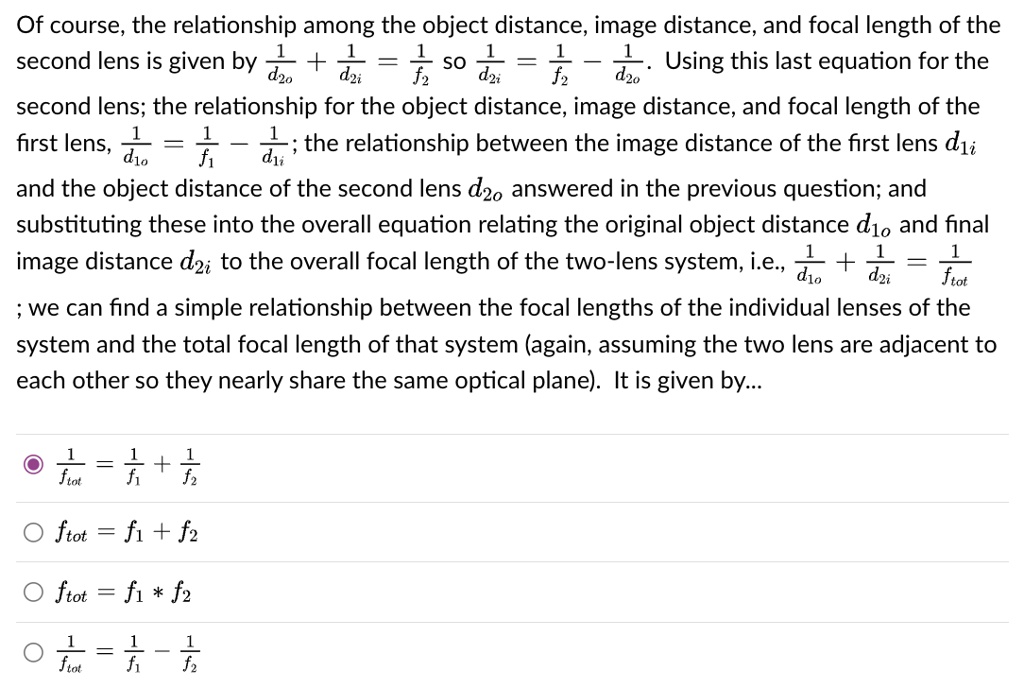
Of course, the relationship among the object distance, image distance, and focal length of the second lens is given by $\frac{1}{d_{2o}} + \frac{1}{d_{2i}} = \frac{1}{f_2}$ so $\frac{1}{d_{2i}} = \frac{1}{f_2} - \frac{1}{d_{2o}}$. Using this last equation for the second lens; the relationship for the object distance, image distance, and focal length of the first lens, $\frac{1}{d_{1o}} = \frac{1}{f_1} - \frac{1}{d_{1i}}$; the relationship between the image distance of the first lens $d_{1i}$ and the object distance of the second lens $d_{2o}$ answered in the previous question; and substituting these into the overall equation relating the original object distance $d_{1o}$ and final image distance $d_{2i}$ to the overall focal length of the two-lens system, i.e., $\frac{1}{d_{1o}} + \frac{1}{d_{2i}} = \frac{1}{f_{tot}}$; we can find a simple relationship between the focal lengths of the individual lenses of the system and the total focal length of that system (again, assuming the two lens are adjacent to each other so they nearly share the same optical plane). It is given by... $\frac{1}{f_{tot}} = \frac{1}{f_1} + \frac{1}{f_2}$ $f_{tot} = f_1 + f_2$ $f_{tot} = f_1 * f_2$ $\frac{1}{f_{tot}} = \frac{1}{f_1} - \frac{1}{f_2}$
View Answer
divider
BEST MATCH

A toy train car of mass 50 kg collides with a stationary empty car of mass 15 kg while moving 5 m/s. At the collision the cars couple together. What is the final velocity of the moving pair?

View Answer
divider
BEST MATCH

THEOREM 7.25 SUBSET-SUM is in NP. PROOF IDEA The subset is the certificate. PROOF The following is a verifier V for SUBSET-SUM. V = "On input ((S, t), c): 1. Test whether c is a collection of numbers that sum to t. 2. Test whether S contains all the numbers in c. 3. If both pass, accept; otherwise, reject." ALTERNATIVE PROOF We can also prove this theorem by giving a nonde- terministic polynomial time Turing machine for SUBSET-SUM as follows. N = "On input (S,t): 1. Nondeterministically select a subset c of the numbers in S. 2. Test whether c is a collection of numbers that sum to t. 3. If the test passes, accept; otherwise, reject."

View Answer
divider
BEST MATCH

$C(z) = \frac{k*z}{z-1}$ $G(z) = \frac{z+1}{z^2 + 0.5z - 0.3}$

View Answer
divider