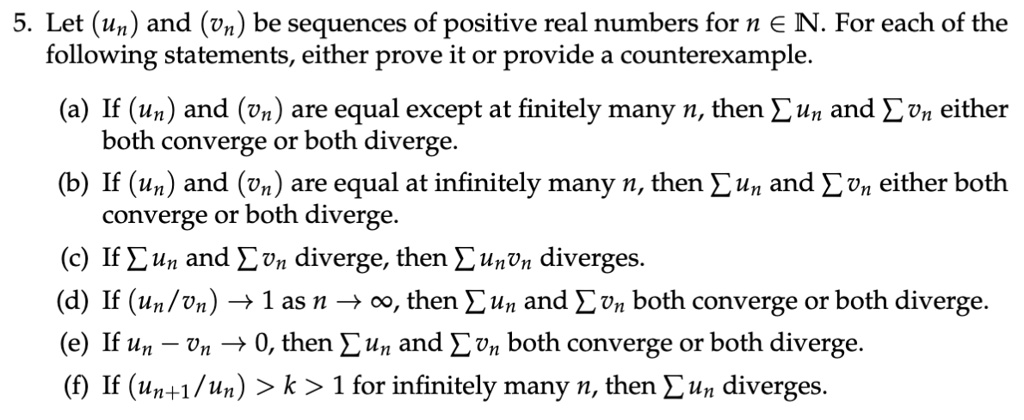
5. Let $(u_n)$ and $(v_n)$ be sequences of positive real numbers for $n \in \mathbb{N}$. For each of the following statements, either prove it or provide a counterexample.
(a) If $(u_n)$ and $(v_n)$ are equal except at finitely many $n$, then $\sum u_n$ and $\sum v_n$ either both converge or both diverge.
(b) If $(u_n)$ and $(v_n)$ are equal at infinitely many $n$, then $\sum u_n$ and $\sum v_n$ either both converge or both diverge.
(c) If $\sum u_n$ and $\sum v_n$ diverge, then $\sum u_n v_n$ diverges.
(d) If $(u_n/v_n) \to 1$ as $n \to \infty$, then $\sum u_n$ and $\sum v_n$ both converge or both diverge.
(e) If $u_n - v_n \to 0$, then $\sum u_n$ and $\sum v_n$ both converge or both diverge.
(f) If $(u_{n+1}/u_n) > k > 1$ for infinitely many $n$, then $\sum u_n$ diverges.