Ace - AI Tutor
Ask Our Educators
Textbooks
My Library
Flashcards
Scribe - AI Notes
Notes & Exams
Download App
austin gordon

austin g.

Divider

Questions asked

BEST MATCH

A paper reported that for a group of 72 college students, the average number of responses changed from the correct answer to an incorrect answer on a test containing 78 multiple-choice items was 0.8. The corresponding standard deviation was reported to be 1.0. Based on this mean and standard deviation, what can you tell about the shape of the distribution of the variable number of answers changed from right to wrong? Since the mean of the distribution is 0.8 answers changed and the standard deviation is 1.0 answers changed,0 answers changed is standard deviations below the mean. If the distribution were approximately normal, then we would expect ---Select--- about 2.5% about 16% about 34% about 50% about 68% about 84% about 97.5% of the students to change fewer than 0 answers. Thus the distribution ---Select--- can cannot be well approximated by a normal curve. There must be some values more than 1 standard deviationabove the mean, that is, values above answers changed. This suggests that the distribution is ---Select--- positively skewed roughly symmetrical negatively skewed . How many standard deviations above the mean is three answers changed? What can you say about the total number of students who changed at least three answers from correct to incorrect? (Round your answer down to the nearest whole number.) At most students changed at least three answers from correct to incorrect.

View Answer
divider
BEST MATCH

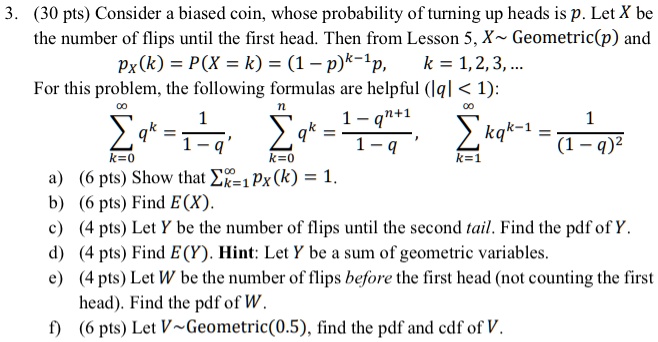
3. (30 pts) Consider a biased coin, whose probability of turning up heads is $p$. Let $X$ be the number of flips until the first head. Then from Lesson 5, $X \sim \text{Geometric}(p)$ and $p_X(k) = P(X = k) = (1 - p)^{k-1}p$, $k = 1, 2, 3, \dots$ For this problem, the following formulas are helpful ($|q| < 1$): \begin{align*} \sum_{k=0}^{\infty} q^k &= \frac{1}{1 - q}, \quad \sum_{k=0}^n q^k = \frac{1 - q^{n+1}}{1 - q}, \quad \sum_{k=1}^{\infty} kq^{k-1} = \frac{1}{(1 - q)^2} \end{align*} a) (6 pts) Show that $\sum_{k=1}^{\infty} p_X(k) = 1$. b) (6 pts) Find $E(X)$. c) (4 pts) Let $Y$ be the number of flips until the second tail. Find the pdf of $Y$. d) (4 pts) Find $E(Y)$. Hint: Let $Y$ be a sum of geometric variables. e) (4 pts) Let $W$ be the number of flips before the first head (not counting the first head). Find the pdf of $W$. f) (6 pts) Let $V \sim \text{Geometric}(0.5)$, find the pdf and cdf of $V$.
View Answer
divider
BEST MATCH

CompTIA Domain 4.0 Security Operations Assessment 44.8% Complete C Assessment | CompTIA Pause Assessment This Question: 01:14 Total: 36:55 In the context of enterprise web management, which method specifically involves the creation and enforcement of criteria\--such as specific URLs, domains, IP addresses, content categories, or keywords within the web content\--to block access to certain web resources proactively? X A x B x C A. Content categorization B. Reputation-based filtering C. URL scanning D. Block rules x D Confirm Difficulty Level: Expert

View Answer
divider
BEST MATCH

A company invests $19,000 to produce a product that will sell for $61.70. Each unit costs $9.20 to produce. (Round your answers to the nearest whole number.) (a) How many units must the company sell to break even? units (b) How many units must the company sell to make a profit of $115,000? units

View Answer
divider
BEST MATCH

How many electrons are present in the O²⁻ anion? Express your answer in electrons as an integer. 4

View Answer
divider
BEST MATCH

Simplify the expression. Assume that all variables are nonnegative real numbers. \(\sqrt[3]{24a^2}\)

View Answer
divider
BEST MATCH

The polynomial of degree 3, $P(x)$, has a root of multiplicity 2 at $x = 1$ and a root of multiplicity 1 at $x = -1$. The $y$-intercept is $y = -0.7$. Find a formula for $P(x)$.

View Answer
divider
BEST MATCH

2. Answer the following questions: 150 Determine the required feedback transfer function $\beta$ to yield a specific phase margin, and determine the resulting closed-loop low-frequency gain. Consider a three-pole feedback amplifier with a loop gain function given by: $\frac{\beta(1000)}{(1 + \frac{j}{10^5})(1 + \frac{j}{5 \times 10^4})(1 + \frac{j}{10^4})}$ i. Determine the value of $\beta$ that yields a phase margin of 45 degrees. ii. Determine the closed loop low frequency gain. iii. At what conditions, this system will be stable?

View Answer
divider
BEST MATCH

Are the sets equal? {42, 23, 25, 27, 29} = {23, 25, 27, 29} Yes No

View Answer
divider
BEST MATCH

QUESTION/ SOALAN 1. Consider the following schema in a university database: student (matricNo, studentName, address, major) course (courseNo, courseName, credit) MARKS/MARKAH Based on the database schema above, you are required to write SQL statement for each of the following: i) Create a new table called \"Result\" with the following structure: resultID (Auto-increment, Primary Key) matricNo (Foreign Key referencing student.matricNo) courseNo (Foreign Key referencing course.courseNo) Grade (VARCHAR(2)) ii) Insert a new result record for a student named \"Harith\" in the \"Database\" course with a grade of \"A\" (assume this record exists in the related table). Display the updated table with all student records. iii) Retrieve the names of students along with their enrolled courses and grades. Sort the result in alphabetical order based on the student names. iv) Retrieve the names of students who are not enrolled in any course. v) Calculate the number of students in the \"Cyber Security\" major. vi) Update the grade of the student named \"Fathin\" in the \"Networking\" course to \"B+\" (assume this record exists in the related table). (Total / Jumlah: 20)

View Answer
divider