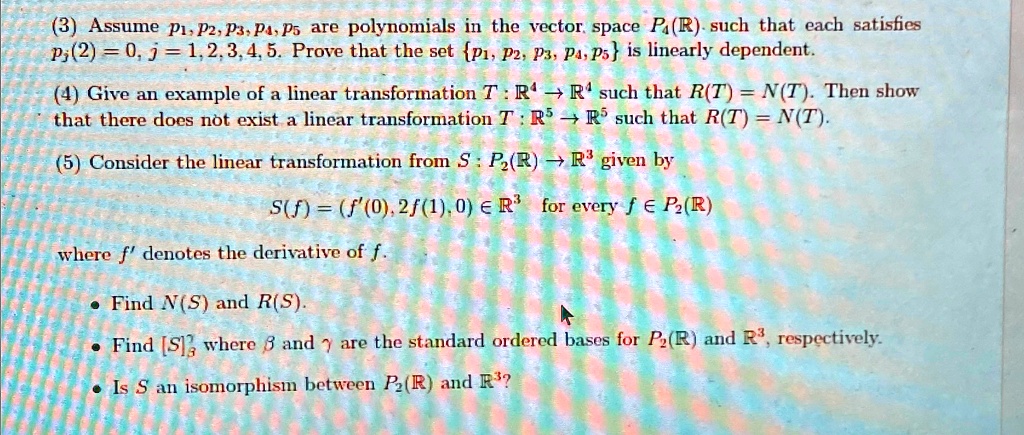
(3) Assume p1, p2, p3, p4, p5 are polynomials in the vector space P4(R) such that each satisfies pj(2) = 0, j = 1, 2, 3, 4, 5. Prove that the set {p1, p2, p3, p4, p5} is linearly dependent.
(4) Give an example of a linear transformation T: R^4 -> R^4 such that R(T) = N(T). Then show that there does not exist a linear transformation T: R^5 -> R^5 such that R(T) = N(T).
(5) Consider the linear transformation from S: P2(R) -> R^3 given by
S(f) = (f'(0), 2f(1), 0) in R^3 for every f in P2(R)
where f' denotes the derivative of f.
Find N(S) and R(S).
Find [S]_(β)^(γ) where β and γ are the standard ordered bases for P2(R) and R^3, respectively.
Is S an isomorphism between P2(R) and R^3?