Ace - AI Tutor
Ask Our Educators
Textbooks
My Library
Flashcards
Scribe - AI Notes
Notes & Exams
Download App
Aws Al Barak

Aws A.

Divider

Viewed Questions

An elevator moves upward at $5.2 \mathrm{m} / \mathrm{s} .$ What's its minimum stopping time if the passengers are to remain on the floor?

An elevator moves upward at $5.2 \mathrm{m} / \mathrm{s} .$ What's its minimum stopping time if the passengers are to remain on the floor?

Essential University Physics

Determine the components of the support reactions at the fixed support $A$ on the cantilevered beam.

Engineering Mechanics: Statics

What is orthogonal projection?

Visualization, Modeling, and Graphics for Engineering Design

A long rod, insulated to prevent heat loss along its sides, is in perfect thermal contact with boiling water (at atmospheric pressure) at one end and with an ice-water mixture at the other (Fig. $\mathbf{E} \mathbf{1 7 . 6 0}$ ). The rod consists of a $1.00 \mathrm{~m}$ section of copper (one end in boiling water) joined end to end to a length $L_{2}$ of steel (one end in the icewater mixture). Both sections of the rod have cross-sectional areas of $4.00 \mathrm{~cm}^{2} .$ The temperature of the copper-steel junction is $65.0^{\circ} \mathrm{C}$ after a steady state has been set up. (a) How much heat per second flows from the boiling water to the ice-water mixture? (b) What is the length $L_{2}$ of the steel section?

A long rod, insulated to prevent heat loss along its sides, is in perfect thermal contact with boiling water (at atmospheric pressure) at one end and with an ice-water mixture at the other (Fig. $\mathbf{E} \mathbf{1 7 . 6 0}$ ). The rod consists of a $1.00 \mathrm{~m}$ section of copper (one end in boiling water) joined end to end to a length $L_{2}$ of steel (one end in the icewater mixture). Both sections of the rod have cross-sectional areas of $4.00 \mathrm{~cm}^{2} .$ The temperature of the copper-steel junction is $65.0^{\circ} \mathrm{C}$ after a steady state has been set up. (a) How much heat per second flows from the boiling water to the ice-water mixture? (b) What is the length $L_{2}$ of the steel section?

University Physics with Modern Physics

Questions asked

ANSWERED

Sanchit Jain verified

Numerade educator

Figure 1 – BJT amplifier, Vs = input, Vc = output Workings for your preliminaries must be shown in the space provided. Refer to the appendix for appropriate values of ? and VBE(on). (i). From the DC viewpoint, draw an equivalent diagram (replacing R1, R2, and VCC with a Thevenin equivalent) for the circuit of Figure 1. Perform a DC analysis on the resulting circuit (Figure 2) to obtain the Q-point. Figure 2 – Equivalent circuit of Figure 1 from the DC viewpoint. ? used is ; VBE(on) used is

View Answer
divider
ANSWERED

Sam Stansfield verified

Numerade educator

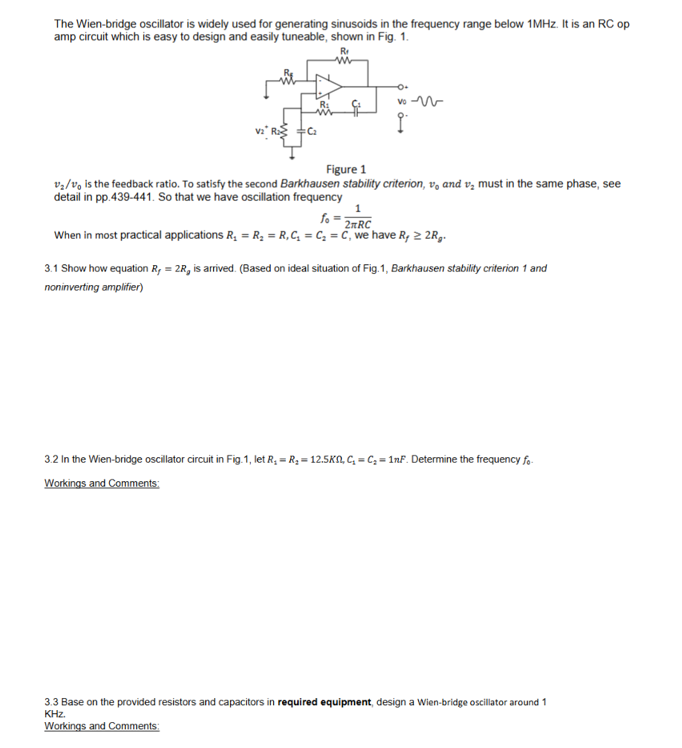
The Wien-bridge oscillator is widely used for generating sinusoids in the frequency range below 1 MHz . It is an RC op amp circuit which is easy to design and easily tuneable, shown in Fig. 1. Figure 1 ( v_{2} / v_{0} ) is the feedback ratio. To satisfy the second Barkhausen stability criterion, ( v_{0} ) and ( v_{2} ) must in the same phase, see detail in pp. 439-441. So that we have oscillation frequency [ f_{0}=frac{1}{2 pi R C} ] When in most practical applications ( R_{1}=R_{2}=R, C_{1}=C_{2}=C ), we have ( R_{f} geq 2 R_{g} ). 3.1 Show how equation ( R_{f}=2 R_{g} ) is arrived. (Based on ideal situation of Fig.1, Barkhausen stability criterion 1 and noninverting amplifier) 3.2 In the Wien-bridge oscillator circuit in Fig.1, let ( R_{1}=R_{2}=12.5 mathrm{~K} Omega, C_{1}=C_{2}=1 n F ). Determine the frequency ( f_{0} ). Workings and Comments: 3.3 Base on the provided resistors and capacitors in required equipment, design a Wien-bridge oscillator around 1 KHz . Workings and Comments:
View Answer
divider
ANSWERED

Sam Stansfield verified

Numerade educator

3.2 1).Design a six-bit digital-to-analog converter with binary weighted ladder type like Fig.2; 2).Find the value of R1, R2, R3, R4, R5 and R6, when Rf = 1K; 3).If V0 = 1.1875V is designed, what should [ V1 V2 V3 V4 V5 V6 ] be? Figure 2 – Four-bit DAC: binary weighted ladder type

View Answer
divider
ANSWERED

Prabhat Tyagi verified

Numerade educator

3.1 Assume the op amp in Fig. 3 as an ideal one, R1=R2=R3=10K, Vs=1V, find V0, i0.

View Answer
divider
ANSWERED

Sam Stansfield verified

Numerade educator

Question 1: Consider the DC circuit in Figure Q1. Determine the current ( I_{o} ) by using nodal method. Figure Q1

View Answer
divider
ANSWERED

Question 6: Consider the following second-order circuit in Figure Q6. (a) Derive the circuit differential equation with the output voltage ( v_{0} ) as the variable with assumption of zero initial values of both ( v_{0}(t) ) and ( d v(t) / d t ); (b) Given that ( R_{1}=1 mathrm{k} oldsymbol{Omega} ), determine the values of capacitors ( C_{1}, C_{2} ) and resistor ( R_{2} ) to ensure that the ratio of the Laplace transform of output voltage ( v_{0} ) to the Laplace transform of input ( v_{ ext {in }} ) satisfies the following relationship: [ frac{V_{o}(s)}{V_{i n}(s)}=frac{10^{6}}{s^{2}+100 s+10^{6}} ] where ( V_{i n}(s) ) and ( V_{o}(s) ) are the Laplace transforms of the input voltage ( v_{i n} ) and the output voltage ( v_{0} ), respectively. Figure Q6

View Answer
divider
ANSWERED

Andreas Papavassiliou verified

Numerade educator

Question 5: The circuit in Figure Q5 is the electrical analog of body functions used in medical schools to study convulsions. The analog is as follows: ( C_{1}= ) Volume of fluid in a drug ( C_{2}= ) Volume of blood stream in a specified region ( R_{1}= ) Resistance in the passage of the drug from the input to the blood stream ( R_{2}= ) Resistance of the excretion mechanism, such as kidney, etc. ( v_{o}= ) Initial concentration of the drug dosage ( v(t)= ) Percentage of the drug in the blood stream (a) Derive the circuit differential equation with ( v(t) ) as the variable; (b) Find the initial values ( vleft(0^{+} ight) )and ( d vleft(0^{+} ight) / d t ); (c) Find ( v(t) ) for ( t>0 ) given that ( C_{1}=0.5 mu mathrm{~F}, C_{2}=5 mu mathrm{~F} ), ( R_{1}=5 mathrm{M} Omega, R_{2}=2.5 mathrm{M} Omega ) and the initial value of the voltage across ( C_{1} ) at ( t=0^{-} )is 60 V . Figure Q5

View Answer
divider
ANSWERED

Andreas Papavassiliou verified

Numerade educator

Question 4: An attenuator probe employed with oscilloscopes was designed to reduce the magnitude of the input voltage ( v_{i} ) by a factor of 10. As shown in Figure Q4, the oscilloscope has internal resistance ( R_{s} ) and capacitance ( C_{s} ), while the probe has an internal resistance ( R_{p} ). (a) Derive the circuit differential equation with the output voltage ( v_{o} ) as the variable; (b) If ( R_{p} ) is fixed at 6 ( MOmega ) ( (6 imes 10^{6} Omega) ), find ( R_{s} ) and ( C_{s} ) for the circuit to have a time constant of 15 ( mu s ) ( (15 imes 10^{-6} ext{ seconds}) ). Figure Q4

View Answer
divider
ANSWERED

Andreas Papavassiliou verified

Numerade educator

Question 3: The op amp circuit shown in Figure Q3 is a current amplifier. Find the current gain ( i_{o} / i_{s} ) of the amplifier. Figure Q3

View Answer
divider
ANSWERED

Andreas Papavassiliou verified

Numerade educator

Question 2: An attenuator is an interface circuit that reduces the voltage level without change the output resistance as shown in Figure Q2. Figure Q2 (a) By specifying ( R_{s} ) and ( R_{p} ) of the interface circuit in Figure Q2, design an attenuator that will meet the following requirements: [ frac{V_{o}}{V_{g}}=0.125, quad R_{e q}=R_{T h}=R_{g}=100 Omega ] (b) Using the interface designed in part (a), calculate the current through a load ( R_{L}= ) ( 100 Omega ) when ( V_{g}=12 mathrm{~V} ).

View Answer
divider