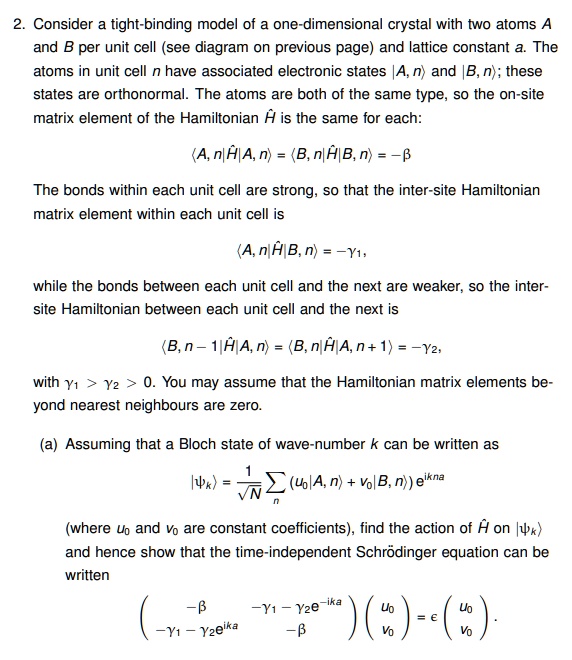
2. Consider a tight-binding model of a one-dimensional crystal with two atoms A
and B per unit cell (see diagram on previous page) and lattice constant a. The
atoms in unit cell $n$ have associated electronic states $|A, n\rangle$ and $|B, n\rangle$; these
states are orthonormal. The atoms are both of the same type, so the on-site
matrix element of the Hamiltonian $H$ is the same for each:
$\langle A, n|H|A, n\rangle = \langle B, n|H|B, n\rangle = -\beta$
The bonds within each unit cell are strong, so that the inter-site Hamiltonian
matrix element within each unit cell is
$\langle A, n|H|B, n\rangle = -\gamma_1$,
while the bonds between each unit cell and the next are weaker, so the inter-
site Hamiltonian between each unit cell and the next is
$\langle B, n - 1|H|A, n\rangle = \langle B, n|H|A, n + 1\rangle = -\gamma_2$,
with $\gamma_1 > \gamma_2 > 0$. You may assume that the Hamiltonian matrix elements be-
yond nearest neighbours are zero.
(a) Assuming that a Bloch state of wave-number $k$ can be written as
$\left|\psi_k\right\rangle = \frac{1}{\sqrt{N}} \sum_n (u_0|A, n\rangle + v_0|B, n\rangle)e^{ikna}$
(where $u_0$ and $v_0$ are constant coefficients), find the action of $H$ on $|\psi_k\rangle$
and hence show that the time-independent Schrödinger equation can be
written
$\begin{pmatrix} -\beta & -\gamma_1 - \gamma_2e^{-ika} \\\ -\gamma_1 - \gamma_2e^{ika} & -\beta \end{pmatrix} \begin{pmatrix} u_0 \\\ v_0 \end{pmatrix} = \epsilon \begin{pmatrix} u_0 \\\ v_0 \end{pmatrix}.$