Ace - AI Tutor
Ask Our Educators
Textbooks
My Library
Flashcards
Scribe - AI Notes
Notes & Exams
Download App
barbara yates

barbara y.

Divider

Questions asked

BEST MATCH

What effect do impurities have on a sample’s melting point? A) Impurities do not have an impact on the melting point of the sample. Graded exam 12/10/24-12/12/24. Copyrighted material you do not have permission to post this question on the internet. B) A sample that contains a small amount of impurities quite often does not melt but sublimes instead. C) While there are exceptions a small amount of impurities lower the observed melting point, regardless of the impurity's melting point. D) Impurities always raise the observed melting point.

View Answer
divider
BEST MATCH

Question 11 (4.762 points) The first reason for the U.S. Cold War policy of "containment" was Soviet installation of nuclear missiles in Cuba economic differences Soviet aggression in Eastern Europe

View Answer
divider
BEST MATCH

2. Inflation Effects on Exchange Rates Assume that the U.S. inflation rate becomes low relative to Canadian inflation. Other thing being equal, how should this affect the (a) U.S. demand for Canadian dollars, (b) supply of Canadian dollars for sale, and (c) equilibrium value of the Canadian dollar? (1 point) A. U.S. demand for the Canadian dollar would decrease B. The supply of Canadian dollars for sale would increase

View Answer
divider
BEST MATCH

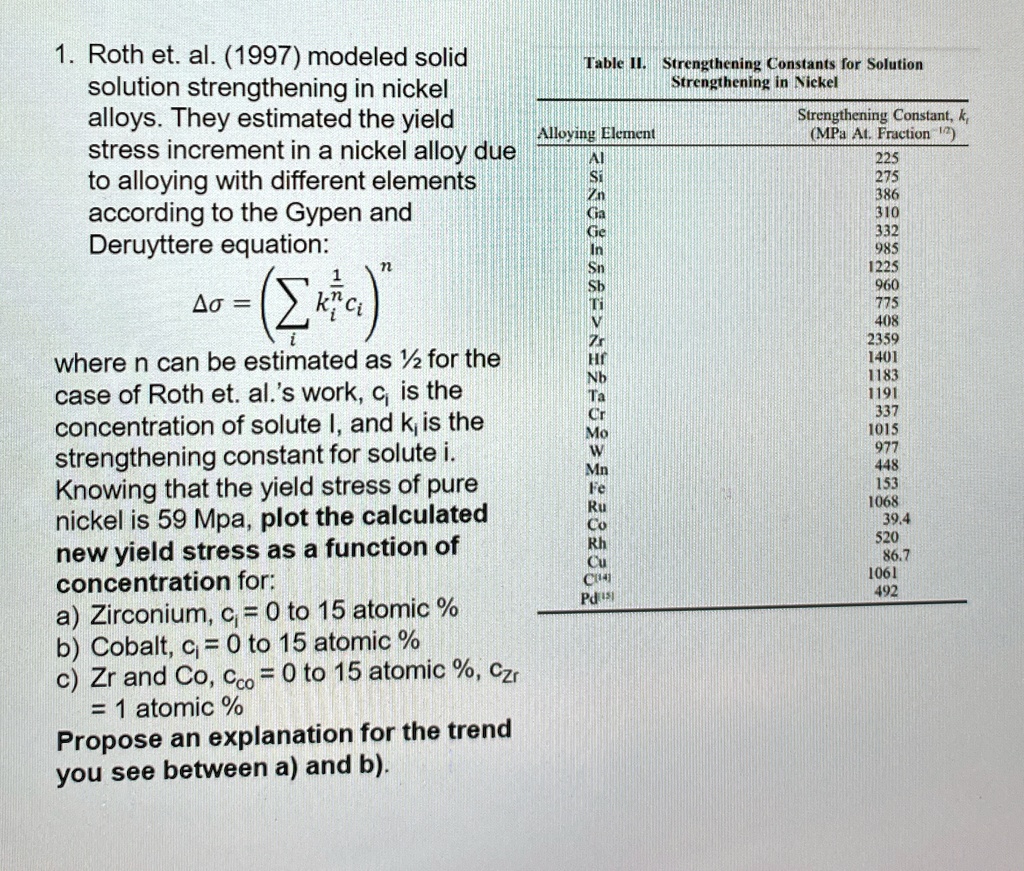
1. Roth et. al. (1997) modeled solid solution strengthening in nickel alloys. They estimated the yield stress increment in a nickel alloy due to alloying with different elements according to the Gypen and Deruyttere equation: $$Δσ = (\sum_{i} k_{i}^{1/n} c_{i})^{n}$$ where n can be estimated as 1/2 for the case of Roth et. al.'s work, c₁ is the concentration of solute I, and k₁ is the strengthening constant for solute i. Knowing that the yield stress of pure nickel is 59 Mpa, plot the calculated new yield stress as a function of concentration for: a) Zirconium, c₁ = 0 to 15 atomic % b) Cobalt, c₁ = 0 to 15 atomic % c) Zr and Co, cco = 0 to 15 atomic %, Czr = 1 atomic % Propose an explanation for the trend you see between a) and b). Table II. Strengthening Constants for Solution Strengthening in Nickel Alloying Element Strengthening Constant, k, (MPa At. Fraction 1/2) Al 225 Si 275 Zn 386 Ga 310 Ge 332 In 985 Sn 1225 Sb 960 Ti 775 V 408 Zr 2359 Hf 1401 Nb 1183 Ta 1191 Cr 337 Mo 1015 W 977 Mn 448 Fe 153 Ru 1068 Co 39.4 Rh 520 Cu 86.7 Cu 1061 Pd 492
View Answer
divider
BEST MATCH

Which of the following statements about rural health disparities is FALSE? Rural communities have higher rates of chronic illness Rural communities have poorer overall health status Report an error question 5 of 5 Rural communities have less access to health care Rural communities have lower uninsured rates.

View Answer
divider
BEST MATCH

Anorexic women have lower self-esteem than non-anorexic women. Type 1 Type 2

View Answer
divider
BEST MATCH

Determine whether the number is divisible by 3. Give a reason based on the tests for divisibility. 49

View Answer
divider
BEST MATCH

Fill in each blank so that the resulting statement is true. $\sum_{i=1}^{n} a_i =$ In this summation notation, i is called the ____ of summation, n is the ____ of summation, and 1 is the ____ of summation Choose the correct terms below. $\sum_{i=1}^{n} a_i =$ In this summation notation, i is called the ____ of summation, n is the ____ of summation, and 1 is the ____ of summation.

View Answer
divider
BEST MATCH

QUESTION 4 Behaviors that are learned easily and by all (or nearly all) individuals in a species are called A. instincts. B. reciprocal altruism. C. prepared learning. D. fixed action patterns. QUESTION 5 Which of the following conditions must be met for reciprocal altruism to evolve? A. The benefits to the recipient must be significantly greater than the costs to the donor. B. The ability to recognize and punish cheaters must exist. C. Repeated interactions among individuals must occur, with opportunities for each individual to be both the donor and the recipient of altruistic-appearing acts. D. The interacting parties must be related to each other. E. Only the first three choices are conditions that must be met for reciprocal altruism to evolve.

View Answer
divider
BEST MATCH

Question 4: a) Show that the grammar given below is ambiguous using parse trees. $\begin{aligned} S &\rightarrow iEtSS' \mid a \\ S' &\rightarrow eS \mid \epsilon \\ E &\rightarrow b \end{aligned}$

View Answer
divider