show how you use it to get the answer.
(f) How long does the ball stay in the air altogether? Refer to previous equations.
(g) What angle with the vertical does the ball make when it reaches the target? You'll need to calculate/use \( v_{x, f} \) and \( v_{y, f} \) for this. Explain how you can do it, and draw a diagram showing the velocity vector, its two components, and the angle in question.
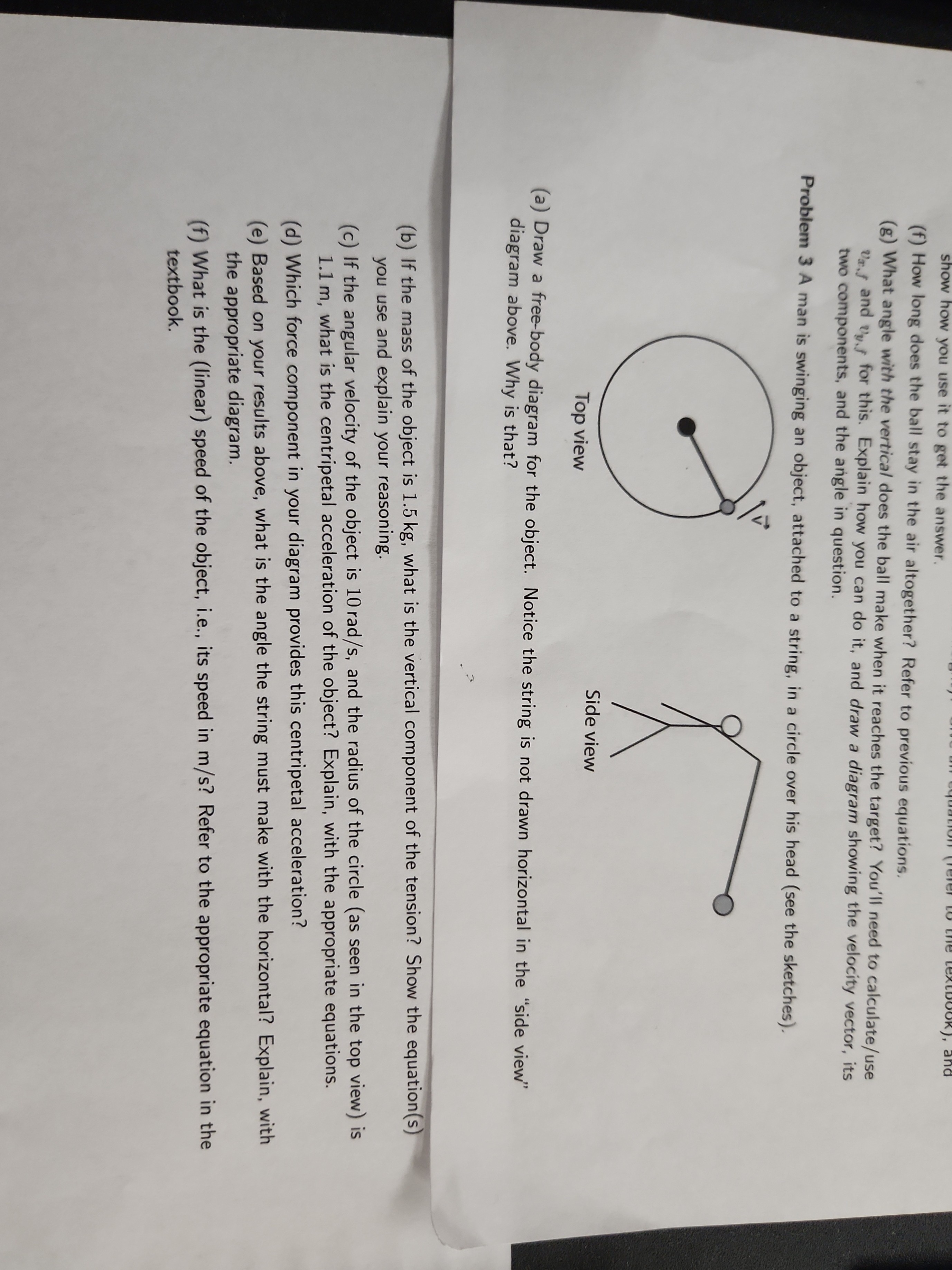
Problem 3 A man is swinging an object, attached to a string, in a circle over his head (see the sketches).
Top view
Side view
(a) Draw a free-body diagram for the object. Notice the string is not drawn horizontal in the "side view" diagram above. Why is that?
(b) If the mass of the object is 1.5 kg , what is the vertical component of the tension? Show the equation(s) you use and explain your reasoning.
(c) If the angular velocity of the object is \( 10 \mathrm{rad} / \mathrm{s} \), and the radius of the circle (as seen in the top view) is 1.1 m , what is the centripetal acceleration of the object? Explain, with the appropriate equations.
(d) Which force component in your diagram provides this centripetal acceleration?
(e) Based on your results above, what is the angle the string must make with the horizontal? Explain, with the appropriate diagram.
(f) What is the (linear) speed of the object, i.e., its speed in \( \mathrm{m} / \mathrm{s} \) ? Refer to the appropriate equation in the textbook.