106 The position vector for a proton is initially \( \vec{r}= \) \( 5.0 \hat{i}-6.0 \hat{j}+2.0 \mathrm{k} \) and then later is \( \vec{r}=-2.0 \hat{i}+6.0 \hat{j}+2.01 \mathrm{j} \), all in meters (a) What is the proton's displacement vector, and (b) to what plane is that vector parallel?
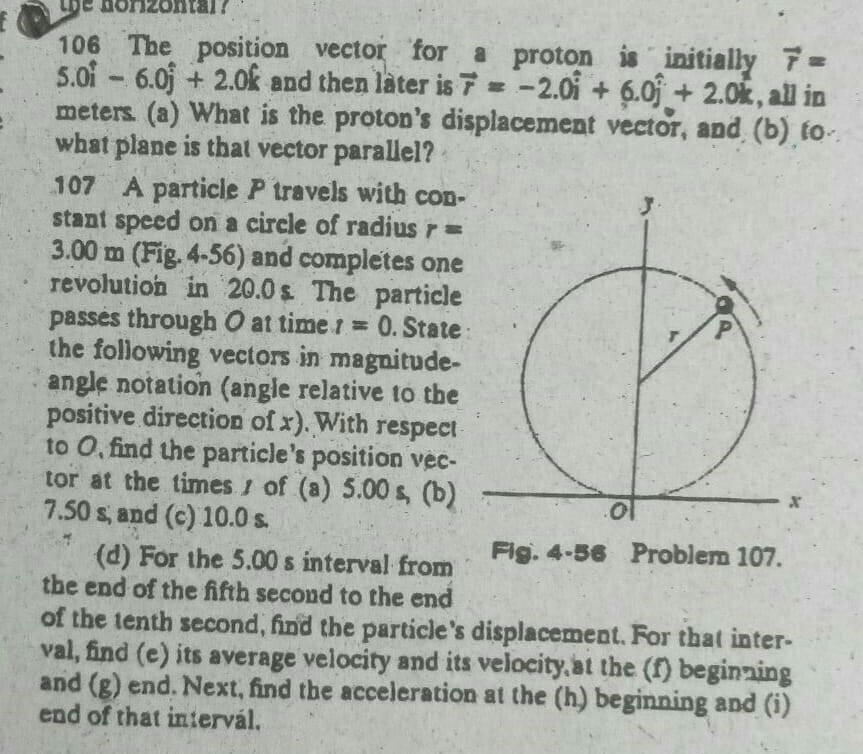
107 A particle \( P \) travels with constant speed on a circle of radius \( r= \) \( 3.00 \mathrm{~m} \) (Fig. 4.56) and completes one revolution in \( 20.0 \) s. The particle passes through \( O \) at time \( t=0 \). State : the following vectors in magnitudeangle notation (angle relative to the positive direction of \( x \) ). With respect to \( O \), find the particle's position vector at the times 1 of (a) \( 5.00 \mathrm{~s} \), (b) \( 7.50 \mathrm{~s} \), and (c) \( 10.0 \mathrm{~s} \).
(d) For the \( 5.00 \mathrm{~s} \) interval from Fg. 4-3s Problem 107. the end of the fifth second to the end of the tenth second, find the particle's displacement. For that interval, find (e) its average velocity and its velocity, at the \( (f) \) beginging and \( (\mathrm{g}) \) end. Next, find the acceleration at the \( (h) \) beginning and (i) end of that interval.