Questions asked
Sanchit Jain
Numerade educator
F Alkenes undergo halogenation. It is an example of a. nucleophilic-electrophilic substitution reaction b. elimination c. nucleophilic substitution d. nucleophilic-electrophilic addition reaction
Taha T
Which statement about the rearrangement of carbocations is not true? A. Rearrangements can involve hydride shifts. B. Rearrangements occur to form less stable carbocations. C. Rearrangements can involve methyl shifts. D. Rearrangements can involve ( 1^{circ} ) carbocations.
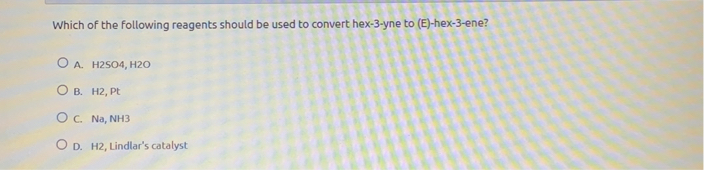
Which of the following reagents should be used to convert hex-3-yne to (E)-hex-3-ene? A. H2SO4, H2O B. H2, Pt C. Na, NH3 D. H2, Lindlar's catalyst
Give the correct name of the following compound Br Cl | | CH3CH2CHCHCH2CH=CH2 a. 5- bromo-4-chloro-1-heptene b. 3-bromo-4-chloro-6-hexene c. 4-choloro-5-bromo-2-hexene d. 4-bormo-5-choloro-1-heptane
The carbon atoms in an alkyne are? a. sp³ hybridized b. sp² hybridized c. sp hybridized d. sp? hybridized
Hydroboration of alkene results in? A. An anti-substitution reaction. B. An anti-Markovnikov addition producing an alcohol. C. An alkyl halide. D. A Markovnikov addition producing an alcohol.
What type of compound is prepared by adding water to propyne in the presence of sulfuric acid and mercuric sulfate? a. carboxylic acid b. ketone c. aldehyde d. Ester
Which of the alkyne addition reactions below involve(s) an enol intermediate? A. hydroboration/oxidation B. treatment with Br2 in presence of CH2CL2 C. hydrogenation D. NONE OF THEM
Markovnikov's rule states? A. Hydrohalides add so that the halide adds to the end of the double bond with the most hydrogen atoms on the carbon. B. Hydrohalides add so that the proton adds to the end of the double bond with the most hydrogen atoms on the carbon. C. Hydrohalides add non-regioselective or non-stereoselective to alkenes. D. Hydrohalides add so that the proton adds to the end of the double bond with the least hydrogen atoms on the carbon.
Addition of H2 to 2-pentyne in the presence of the Lindlar's catalyst will produce: a. trans-2-pentene b. pentane c. 1-pentene d. cis-2-pentene