Ace - AI Tutor
Ask Our Educators
Textbooks
My Library
Flashcards
Scribe - AI Notes
Notes & Exams
Download App
alisha bibi

Aisha

Divider

Questions asked

ANSWERED

Tavis Lam verified

Numerade educator

PROBLEM 2.34 Determine the resultant of the three forces of Problem 2.22. PROBLEM 2.22 Determine the x and y components of each of the forces shown.

View Answer
divider
ANSWERED

Tavis Lam verified

Numerade educator

PROBLEM 2.33 Determine the resultant of the three forces of Problem 2.24. PROBLEM 2.24 Determine the x and y components of each of the forces shown.

View Answer
divider
ANSWERED

Ivan Kochetkov verified

Numerade educator

Member BD exerts on member ABC a force P directed along line BD. Knowing that P must have a 300-lb horizontal component, determine (a) the magnitude of the force P, (b) its vertical component.

View Answer
divider
ANSWERED

Tavis Lam verified

Numerade educator

Three point charges are located on a circular arc as shown in the figure below. Let r = 3.50 cm. Let to the right be the +x-direction and up along the screen be the +y direction. +3.00 nC r 30.0° -2.00 nC P 30.0° r +3.00 nC (a) What is the total electric field at P, the center of the arc? E = (____ i + ____ j) N/C (b) Find the electric force that would be exerted on a -4.50-nC point charge placed at P. F = (____ i + ____ j) N

View Answer
divider
ANSWERED

Tavis Lam verified

Numerade educator

Three charged particles are at the corners of an equilateral triangle as shown in the figure below. (Let q = 4.00 µC, and L = 0.550 m.) y 7.00 µC L 60.0° x q -4.00 µC (a) Calculate the electric field at the position of charge q due to the 7.00-µC and -4.00-µC charges. Once you calculate the magnitude of the field contribution from each charge, you need to add these as vectors. kN/C i + kN/C j Does the -4.00-µC charge contribute to the y component of the field at the origin? (b) Use your answer to part (a) to determine the force on charge q. You appear to have correctly calculated the force using your incorrect result from part (a). mN i + mN j You appear to have correctly calculated the force using your incorrect result from part (a).

View Answer
divider
ANSWERED

Tavis Lam verified

Numerade educator

A small object of mass 3.84 g and charge -17 ?C is suspended motionless above the ground when immersed in a uniform electric field perpendicular to the ground. What are the magnitude and direction of the electric field? magnitude N/C direction downward

View Answer
divider
ANSWERED

Tavis Lam verified

Numerade educator

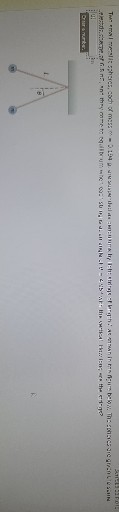
Two small metallic spheres, each of mass m = 0.194 g, are suspended as shown below by light strings of length L, as shown in the figure below. The spheres are given the same electric charge of 6.5 nC, and they come to equilibrium when each string forms an angle of ? = 4.85° with the vertical. How long are the strings?
View Answer
divider
ANSWERED

Ivan Kochetkov verified

Numerade educator

Two small metallic spheres, each of mass m = 0.190 g, are suspended as pendulums by light strings of length L as shown in the figure below. The spheres are given identical charges q1 = q2 = q, and they come to equilibrium when each string is at an angle ? = 4.80° with the vertical. How long are the strings? m

View Answer
divider
ANSWERED

Ivan Kochetkov verified

Numerade educator

Three point charges lie along a straight line as shown in the figure below, where q? = 6.48 ?C, q? = 1.62 ?C, and q? = -2.34 ?C. The separation distances are d? = 3.00 cm and d? = 2.00 cm. Calculate the magnitude and direction of the net electric force on each of the charges. (a) q? magnitude direction (b) q? magnitude direction (c) q? magnitude direction

View Answer
divider
ANSWERED

Ivan Kochetkov verified

Numerade educator

(a) Find the magnitude of the electrostatic force between a Na? ion and a Cl? ion separated by 0.92 nm. N (b) Would the answer change if the sodium ion were replaced by Li? and the chloride ion by Br?? Yes No Explain.

View Answer
divider