Ace - AI Tutor
Ask Our Educators
Textbooks
My Library
Flashcards
Scribe - AI Notes
Notes & Exams
Download App
Ayushi

Ayushi

Divider

Questions asked

INSTANT ANSWER

65. The figure shows an opamp circuit with a 5.1 V Zener diode in the feedback loop. The opamp runs from \( \pm 15 \mathrm{~V} \) supplies. If a \( +1 V \) signal is applied at the input, the output voltage (rounded off to one decimal place) is 4 ANSWER KEY \begin{tabular}{|c|c|c|c|} \hline 1. & (d) & 2. & (d) \\ \hline 3. & (c) & 4. & (a) \\ \hline 5. & (b) & 6. & (b) \\ \hline 7. & (c) & 8. & (a) \\ \hline 9. & (b) & 10 & (b) \\ \hline \end{tabular}

View Answer
divider
INSTANT ANSWER

?? ???? ?? ?? ???? ??? In a scattering experiment, a bearn of \( e^{-} \)with an energy of 420 MeV scatlers off an atomic nucleus. If the first minimum of the diflerential cross section is observed at a scattering angle of \( 45^{\circ} \), the radius of the nucleus (in fermi) is closest to 1. 0.4 2. 8.0 3. 2.5 4. 0.8 ???? ????????? ?????? ???, 420 MeV ????? ?? \( e^{-} \)?? ????? ?????? ?? ????? ?? ?????????? ?? ????

View Answer
divider
INSTANT ANSWER

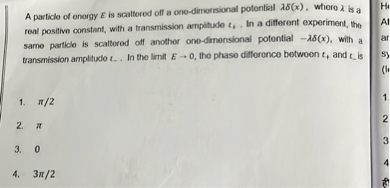
A particlo of enorgy \( E \) is scattored off a ono-dimonsional potontiall \( \lambda \delta(x) \), whore \( \lambda \) is a real positive constant, with a transmission ampitude \( z_{1} \). In a different experiment, the same particlo is scattored off anothor one-dimensional potontial \( -\lambda \delta(x) \), with a transmission amplitudo \( L_{\text {}} \). In the limil \( E \rightarrow 0 \), the phase difference botwoen \( t_{+} \)and \( t_{-} \)is 1. \( \pi / 2 \) 2. \( \pi \) 3. 0 4. \( 3 \pi / 2 \)
View Answer
divider
INSTANT ANSWER

113. The differential scattering crosssection for s-wave scattering in terms of phase shift \( \left(\delta_{0}\right) \) is given by (1) \( \sigma_{0}[\theta]=\frac{\sin ^{2} \delta_{0}}{\mathrm{k}^{2}} \) (2) \( \sigma_{0}[\theta]=\frac{\sin \delta_{0}}{\mathrm{k}} \) (3) \( \sigma_{0}[\theta]=\frac{4 \pi}{\mathrm{k}} \sin ^{2} \delta_{0} \) (4) \( \sigma_{0}[\theta]=\frac{4 \pi}{\mathrm{k}^{2}} \sin \delta_{0} \) (5) Question not attempted

View Answer
divider
INSTANT ANSWER

112. Consider scattering from a central potential \( \mathrm{V}(\mathrm{r})=\alpha / \mathrm{r}^{2} \) where \( \alpha \) is a constant. On using the Born approximation, the differential scattering cross-section is given by (Given \( \int_{0}^{\infty} \frac{\sin x}{x} \mathrm{~d} x=\pi / 2 \) and symbols have their usual meanings. (1) \( \sigma(\theta)=\frac{\pi^{2} \mu^{2} \alpha^{2}}{4 q^{2} \hbar^{4}} \) (2) \( \sigma(\theta)=\frac{\pi^{2} \mu^{2} \alpha^{2}}{q^{2} \hbar^{4}} \) (3) \( \sigma(\theta)=\frac{\pi^{2} \mu^{2} \alpha^{2}}{2 q^{2} \hbar^{4}} \) (4) \( \sigma(\theta)=\frac{2 \pi^{2} \mu^{2} \alpha^{2}}{q^{2} \hbar^{4}} \) (5) Question not attempted

View Answer
divider
INSTANT ANSWER

An electron in the \( n=3, l=0 \), \( \mathrm{m}=0 \) state of hydrogen atom has to reach by electric dipole transitions to ground state. Which of the following transition is not possible ? (here|nlm> represents the state) (1) \( |300>\rightarrow| 200>\rightarrow|100\rangle \) (2) \( |300\rangle \rightarrow|210\rangle \rightarrow|100\rangle \) (3) \( |300>\rightarrow| 211>\rightarrow|100\rangle \) (4) \( |300\rangle \rightarrow|21-1\rangle \rightarrow|100\rangle \) (5) Question not attempted

View Answer
divider
INSTANT ANSWER

118. At temperature \( 300 \mathrm{~K} \), five moles of ideal monoatomic gas occupies a volume V. If gas is expanded adiabatically till its volume becomes \( 2 \sqrt{2} \mathrm{~V} \), then change in the internal energy in the process is (1) \( +9375 \mathrm{~J} \) (3) \( -6325 \mathrm{~J} \) (2) \( -9375 \mathrm{~J} \) (5) Question not attempted

View Answer
divider
INSTANT ANSWER

\( \begin{array}{l}\overline{\Omega_{1}}=\frac{\overline{k_{B} T}}{} \\ \frac{\Omega_{2}}{\Omega_{1}}=l_{\mathrm{n}} \frac{\mathrm{P} \Delta \mathrm{V}}{\mathrm{k}_{\mathrm{B}} \mathrm{T}} \\ \frac{\Omega_{2}}{\Omega_{1}}=\exp \frac{\mathrm{P} \Delta \mathrm{V}}{\mathrm{k}_{\mathrm{p}} T} \\\end{array} \)

View Answer
divider
INSTANT ANSWER

which the solid must be cooled so that more than \( 60 \% \) of the atom are polarized with their magneti moments parallel to the magneti field is given by (Here \( k \) i Boltzmann constant) (1) \( T=\frac{2 \mu B}{k \ln 3} \) (2) \( \mathrm{T}=\frac{\mu \mathrm{B}}{\mathrm{k} \ln 3} \)

View Answer
divider