Ace - AI Tutor
Ask Our Educators
Textbooks
My Library
Flashcards
Scribe - AI Notes
Notes & Exams
Download App
Lucy Gregg

Lucy G.

Divider

Questions asked

ANSWERED

Velocity Addition: The need to keep all speeds less than or equal to the speed of light means that the Galilean rule for adding velocities that we started this unit with must not be correct. In special relativity if an object is moving at speed u' to the right in a reference frame which is itself moving relative to another reference frame to the right at speed v, then the speed of the object as measured in that reference frame is u=(u'+v)/(1+u'v/c^2) . 6. Set up an Excel spreadsheet for the above relationship. Compute u (express all velocities as a fraction of c) for the following u', v values. Keep enough significant figures to show the difference (start with 5 significant figures). Remember to be careful with brackets. u'=0.1c, v=0.1c u'=0.9c, v=0.1c u'=0.9c, v=0.5c u'=0.9c, v=0.9c u'=0.99c, v=0.99c

View Answer
divider
ANSWERED

5. a) Considering the scenario from Question 3, determine the kinetic energy (relativistic) which the spaceship would possess when traveling. Assume a mass of 120,000 kg. b) Compare this energy (ratio) to the kinetic energy of a space shuttle re-entering Earth's atmosphere, which is about 3.12×10¹² J . c) How feasible is interstellar travel at this time?

View Answer
divider
ANSWERED

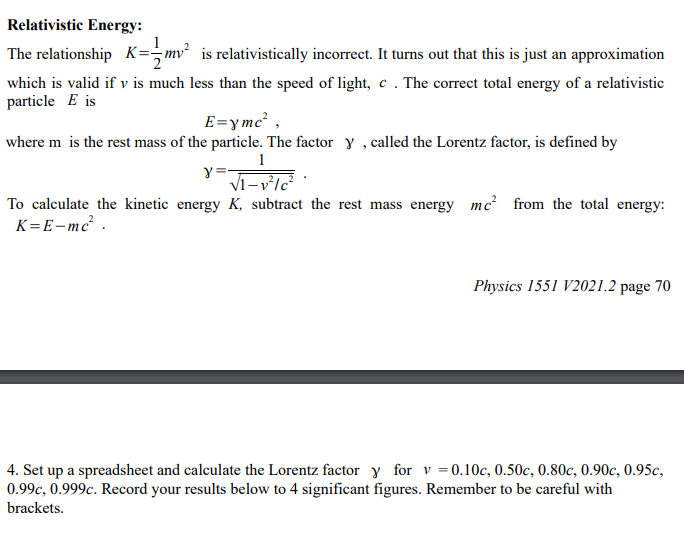
Relativistic Energy: The relationship K=1/2 mv^2 is relativistically incorrect. It turns out that this is just an approximation which is valid if v is much less than the speed of light, c . The correct total energy of a relativistic particle E is E = ??mc^2 , where m is the rest mass of the particle. The factor ?? , called the Lorentz factor, is defined by ?? = 1 / ?(1 ? v^2/c^2) . To calculate the kinetic energy K, subtract the rest mass energy mc^2 from the total energy: K = E ? mc^2 . 4. Set up a spreadsheet and calculate the Lorentz factor ?? for v = 0.10c, 0.50c, 0.80c, 0.90c, 0.95c, 0.99c, 0.999c. Record your results below to 4 significant figures. Remember to be careful with brackets.
View Answer
divider
ANSWERED

3. Astronomers have determined that the star Regulus is about 78 light years from the Earth. A spaceship travels from Earth to Regulus at the speed of 0.900 c . By how much will the astronauts age during this trip? b) What distance will the spaceship measure for the trip?

View Answer
divider
ANSWERED

2. Now let us apply the same concept to a length measurement. Lengths have a similar complication as times in that they depend on the reference frame via ? x ' = ? x ? 1 ? v² / c² . a) Which one is the longer length? Circle one: ? x ' or ? x . b) Proper length of an object is measured in the frame where the object is at rest. The proper length of the moving train in the example above is measured by (circle one): the passenger or the railway station manager. c) The proper length is the longer length ? x in the equation above. Now let us consider the distance between the railway stations. Who measures the proper length (in this case the distance) between these? Circle one: the passenger or the railway station manager.

View Answer
divider
ANSWERED

Proper Time and Proper Length: The time dilation result from the previous activity is ( Delta t^{prime}=Delta t sqrt{1-v^{2} / c^{2}} ). 1. Assume you travel from ( mathrm{A} ) to ( mathrm{B} ) on a train with constant velocity. An important idea is that your reference frame is just as valid as that of the train stations. Assume one clock on the train station from which you leave and one on your wrist. The time between departure and arrival read on these clocks are be related by the equation above. The clock that is present at departure and arrival reads the shorter time. This clock is (circle one): the train station clock ( quad ) or ( quad ) your wristwatch This process is about two events: departure and arrival. Seen from one of the train stations, both events happen at different points in space and time. Seen from the train, they happen at different times but the same point in space. The train frame "owns" these two events, and it measures the proper time between them, which is also the shortest time between them. That would be ( Delta t^{prime} ) in the equation above.

View Answer
divider
ANSWERED

Imagine an electron moving in a uniform 0.25 T magnetic field; its velocity components parallel and perpendicular to the field are both 3.1 Mm/s. With a speed of 4.38Mm/s and a radius of 71um. How far does it move along the field direction in the time it takes to complete a full orbit about the field?

View Answer
divider
ANSWERED

10. What particle is missing in the reaction? ?? ? e? + ?_? + ?

View Answer
divider
ANSWERED

8. The positively charged pion ( pi^{+} ) is a meson with an electrical charge of +1 and it has no strangeness, charm, topness or bottomness. What must be its quark combination? 9. Would the reaction ( pi^{+} ightarrow overline{v_{mu}}+p+mu^{-} ) be allowed? Explain your reasoning by filling in the following table. egin{tabular}{|l|c|c|c|c|c|} hline & ( pi^{+} ) & ( ar{v}_{mu} ) & ( p ) & ( mu ) & Conserved? \ hline Charge: & 1 & & & & \ hline Baryon #: & 0 & & & & \ hline ( mathrm{L}_{mathrm{e}} ) & 0 & & & & \ hline ( mathrm{L}_{mu} ) & 0 & & & & \ hline end{tabular}

View Answer
divider
ANSWERED

6. Consider the reaction n ? p + e? + ???. (Note: the reaction says a neutron can decay into a proton and an electron and an antimatter electron neutrino.) a) Verify that the charge, electron lepton number and baryon number are balanced. b) The weak interaction does not preserve the quark type. Which quark is changed to which other quark? c) Is this reaction allowed?

View Answer
divider