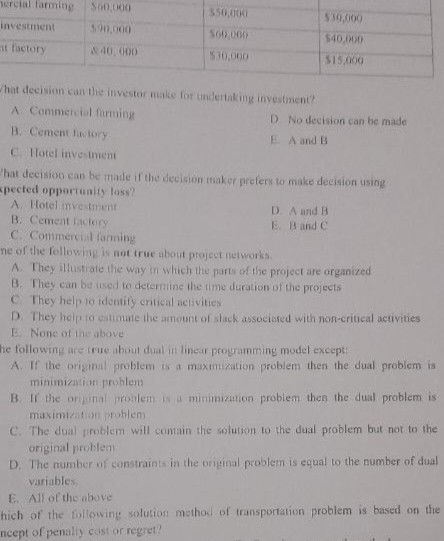
\begin{tabular}{|l|l|l|l|}
\hline insestment & \( \$ 00,000 \) & \( \$ 50,006 \) & \( \$ 30,000 \) \\
\hline It fistory & \( \$ 40,000 \) & \( \$ 00,000 \) & \( \$ 40,000 \) \\
\hline & & \( \$ 30,000 \) & \( \$ 15,000 \) \\
\hline
\end{tabular}
hat decision can the investor make for thadeitaking investment"
A Commersial farming
B. Cement hatory
D. No decision can be made
f.. \( A \) and \( B \)
C. Hotel invesiment
hat decisiot can be made if the declsion maker pretern to make decision using spected opportunity loss?
A Hotel inve thent
D. \( A \) und \( B \)
B. Cement hacrery
E. \( B \) and \( C \)
C. Commercillamming
ne of the following in nat true about project networks.
A. They illustrale the way in which the parts of the project are organized
B. They can be used to determine the time duration of the projects
C. They help Io identily critical netivities
D They help io sitimate the amount of slack associared with non-critteal activities
E. None of the above
he following are (rue abour dual in linear programming model except:
A. If the origimal problem is a maximization problem then the dual problem is minimization problem
B. If the onfinal proslem if a minmmization problem then the dual problem is maximization problem
C. The dual firoblem will ecintain the solution to the dual problem but not to the original prohlem
D. The number of constrains in the orifinal problem is cqual to the number of dual variables,
E. All of the abs)ve
hich of the following solution method of Iransportation problem is based on the ncept of penaly cost or regret?