C. 3
D. 2
E. 4
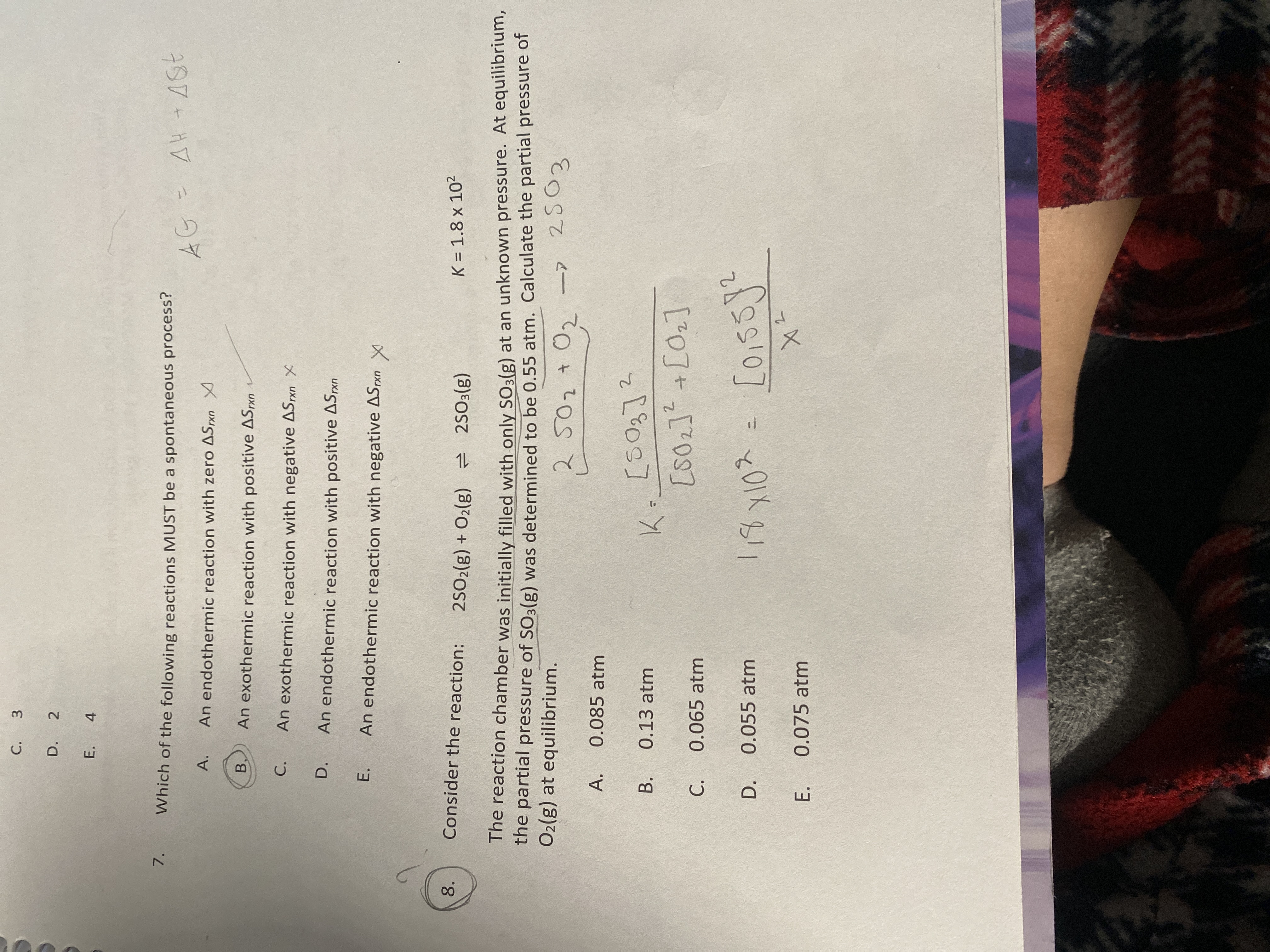
7. Which of the following reactions MUST be a spontaneous process?
A. An endothermic reaction with zero \( \Delta S_{r \times n} \) \( \qquad \)
B. An exothermic reaction with positive \( \Delta S_{r \times n} \) \( \qquad \)
C. An exothermic reaction with negative \( \Delta S_{r \times n} \times \)
D. An endothermic reaction with positive \( \Delta S_{r x n} \)
E. An endothermic reaction with negative \( \Delta S_{r \times n} \)
\( x \)
8. Consider the reaction: \( 2 \mathrm{SO}_{2}(\mathrm{~g})+\mathrm{O}_{2}(\mathrm{~g}) \rightleftharpoons 2 \mathrm{SO}_{3}(\mathrm{~g}) \quad \mathrm{K}=1.8 \times 10^{2} \)
The reaction chamber was initially filled with only \( \mathrm{SO}_{3}(\mathrm{~g}) \) at an unknown pressure. At equilibrium, the partial pressure of \( \mathrm{SO}_{3}(\mathrm{~g}) \) was determined to be \( 0.55 \mathrm{~atm} \). Calculate the partial pressure of \( \mathrm{O}_{2}(\mathrm{~g}) \) at equilibrium.
\[
2 \mathrm{SO}_{2}+\mathrm{O}_{2} \rightarrow 2 \mathrm{SO}_{3}
\]
A. \( 0.085 \mathrm{~atm} \)
B. \( \quad 0.13 \mathrm{~atm} \)
\[
K=\frac{\left[\mathrm{SO}_{3}\right]^{2}}{\left[\mathrm{SO}_{2}\right]^{2}+\left[\mathrm{O}_{2}\right]}
\]
C. \( 0.065 \mathrm{~atm} \)
D. \( 0.055 \mathrm{~atm} \)
\[
1,8 \times 10^{2}=\frac{[0,55]^{2}}{x^{2}}
\]
E. \( \quad 0.075 \mathrm{~atm} \)