Ace - AI Tutor
Ask Our Educators
Textbooks
My Library
Flashcards
Scribe - AI Notes
Notes & Exams
Download App
Jenny Cook

Jenny C.

Divider

Questions asked

INSTANT ANSWER

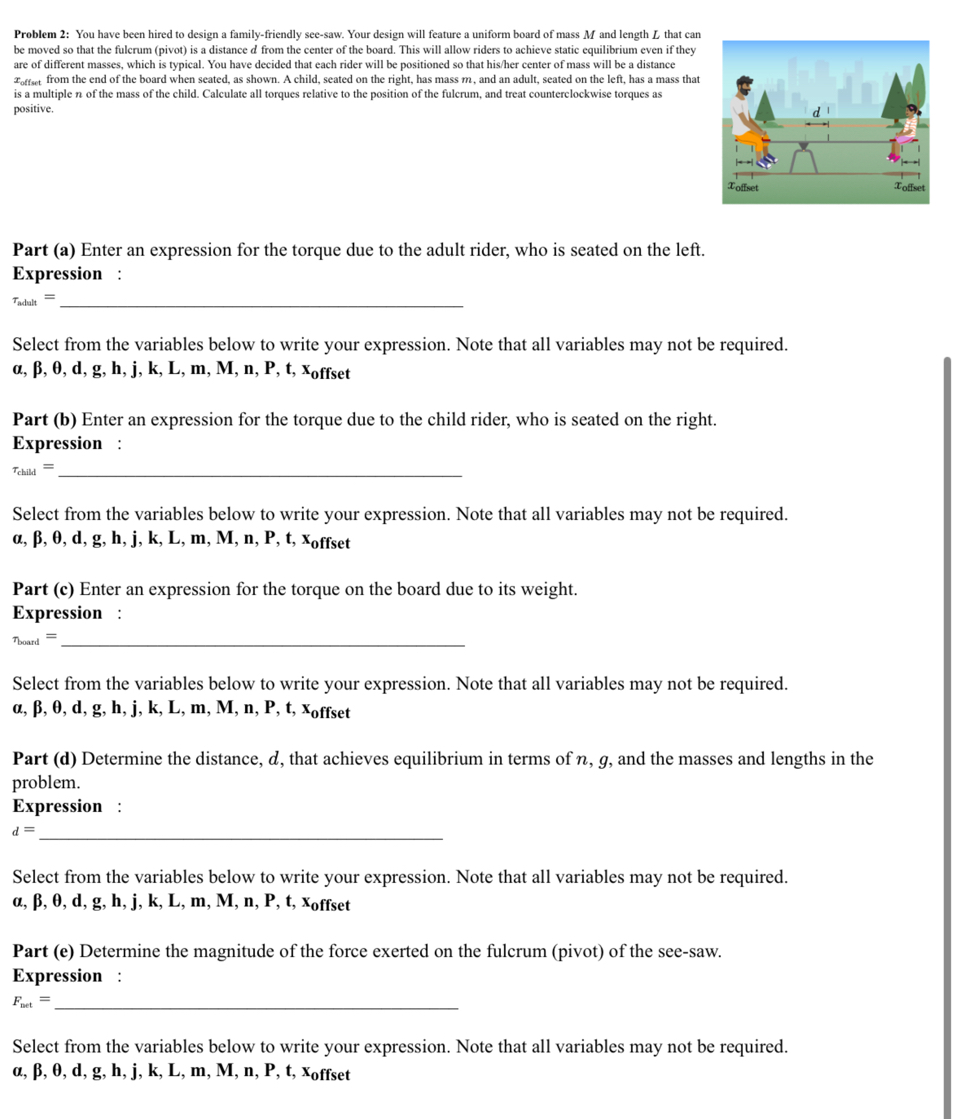
Problem 2: You have been hired to design a family-friendly see-saw. Your design will feature a uniform board of mass \( M \) and length \( L \) that can be moved so that the fulcrum (pivot) is a distance \( d \) from the center of the board. This will allow riders to achieve static equilibrium even if they are of different masses, which is typical. You have decided that each rider will be positioned so that his/her center of mass will be a distance \( x_{\text {offset }} \) from the end of the board when seated, as shown. A child, seated on the right, has mass \( m \), and an adult, seated on the left, has a mass that is a multiple \( n \) of the mass of the child. Calculate all torques relative to the position of the fulcrum, and treat counterclockwise torques as positive. Part (a) Enter an expression for the torque due to the adult rider, who is seated on the left. Expression : \[ \tau_{\text {adult }}= \] \( \_\_\_\_ \) Select from the variables below to write your expression. Note that all variables may not be required. \[ \boldsymbol{\alpha}, \boldsymbol{\beta}, \boldsymbol{\theta}, \mathbf{d}, \mathbf{g}, \mathbf{h}, \mathbf{j}, \mathbf{k}, \mathbf{L}, \mathbf{m}, \mathbf{M}, \mathbf{n}, \mathbf{P}, \mathbf{t}, \mathbf{x}_{\text {offset }} \] Part (b) Enter an expression for the torque due to the child rider, who is seated on the right. Expression : \[ \tau_{\text {child }}= \] \( \_\_\_\_ \) Select from the variables below to write your expression. Note that all variables may not be required. \[ \boldsymbol{\alpha}, \boldsymbol{\beta}, \boldsymbol{\theta}, \mathbf{d}, \mathbf{g}, \mathbf{h}, \mathbf{j}, \mathbf{k}, \mathbf{L}, \mathbf{m}, \mathbf{M}, \mathbf{n}, \mathbf{P}, \mathbf{t}, \mathbf{x}_{\text {offset }} \] Part (c) Enter an expression for the torque on the board due to its weight. Expression : \[ \tau_{\text {board }}= \] \( \_\_\_\_ \) Select from the variables below to write your expression. Note that all variables may not be required. \[ \boldsymbol{\alpha}, \boldsymbol{\beta}, \boldsymbol{\theta}, \mathbf{d}, \mathbf{g}, \mathbf{h}, \mathbf{j}, \mathbf{k}, \mathbf{L}, \mathbf{m}, \mathbf{M}, \mathbf{n}, \mathbf{P}, \mathbf{t}, \mathbf{x}_{\text {offset }} \] Part (d) Determine the distance, \( d \), that achieves equilibrium in terms of \( n, g \), and the masses and lengths in the problem. Expression : \[ d= \] \( \_\_\_\_ \) Select from the variables below to write your expression. Note that all variables may not be required. \[ \boldsymbol{\alpha}, \boldsymbol{\beta}, \boldsymbol{\theta}, \mathbf{d}, \mathbf{g}, \mathbf{h}, \mathbf{j}, \mathbf{k}, \mathbf{L}, \mathbf{m}, \mathbf{M}, \mathbf{n}, \mathbf{P}, \mathbf{t}, \mathbf{x}_{\text {offset }} \] Part (e) Determine the magnitude of the force exerted on the fulcrum (pivot) of the see-saw. Expression : \[ F_{\mathrm{net}}= \] \( \_\_\_\_ \) Select from the variables below to write your expression. Note that all variables may not be required. \[ \boldsymbol{\alpha}, \boldsymbol{\beta}, \boldsymbol{\theta}, \mathbf{d}, \mathbf{g}, \mathbf{h}, \mathbf{j}, \mathbf{k}, \mathbf{L}, \mathbf{m}, \mathbf{M}, \mathbf{n}, \mathbf{P}, \mathbf{t}, \mathbf{x}_{\text {offset }} \]
View Answer
divider
INSTANT ANSWER

Problem 2. Find the general solution for the following second order equation: \[ y^{\prime \prime}-y^{\prime}+9 y=3 \sin (3 t) \] (a) Using the Method of Undetermined Coefficients; (b) Using Variation of Parameters.

View Answer
divider
INSTANT ANSWER

MAT 341: Applied Math 1, Fall 2025 Take home quiz, due 10/30 Problem 1. Find the general solution for the first order linear equation: \[ 2 x^{\prime}+x=3 t^{2} \] (a) Using the Integrating Factor Method; (b) Using the Method of Undetermined Coefficients. Problem 2. Find the general solution for the following second order equation: \[ y^{\prime \prime}-y^{\prime}+9 y=3 \sin (3 t) \] (a) Using the Method of Undetermined Coefficients; (b) Using Variation of Parameters.

View Answer
divider
INSTANT ANSWER

2. Complete the full setup for this systematic equilibrium problem (i.e., come up with \( n \) equations for the \( n \) aqueous species in the system by following our four steps): 0.02 mol \( \mathrm{Ca}\left(\mathrm{NO}_{3}\right)_{2}(s), 0.05 \mathrm{~mol} \mathrm{BaCO}_{3}(s) \), and \( 0.03 \mathrm{~mol} \mathrm{PbCl}_{2}(\mathrm{~s}) \) are added to 1 L of boiled DI water in a closed beaker. For complexation: although your text does have complexation constants for \( \mathrm{BaOH}^{+} \)and \( \mathrm{CaOH}^{+} \), these complexes are rare enough that they can be neglected. But you *should consider \( \mathrm{Pb}^{2+} \) complexes.

View Answer
divider
INSTANT ANSWER

5. Complete the problem we discussed/set up in class: \( \mathrm{Ca}\left(\mathrm{IO}_{3}\right)_{2}(\mathrm{~s}) \) has \( \mathrm{K}_{\mathrm{sp}}=7.1 \times 10^{-7} \) at \( 25^{\circ} \mathrm{C} \cdot \mathrm{a}_{\mathrm{c} 24+}=600 \mathrm{pm}, \mathrm{a}_{\mathrm{lo3}-}= \) 450 pm . How much more \( \mathrm{Ca}\left(\mathrm{IO}_{3}\right)_{2}(\mathrm{~s}) \) will dissolve in a 0.01 M ionic strength (e.g., 0.01 M NaCl ) solution compared to DI \( \mathrm{H}_{2} \mathrm{O} \) ? Give your answer in percent.

View Answer
divider
INSTANT ANSWER

2. Complete the full setup for this systematic equilibrium problem (i.e., come up with \( n \) equations for the \( n \) aqueous species in the system by following our four steps): 0.02 mol \( \mathrm{Ca}\left(\mathrm{NO}_{3}\right)_{2}(\mathrm{~s}), 0.05 \mathrm{~mol} \mathrm{BaCO}_{3}(\mathrm{~s}) \), and \( 0.03 \mathrm{~mol} \mathrm{PbCl}_{2}(\mathrm{~s}) \) are added to 1 L of boiled DI water in a closed beaker. For complexation: although your text does have complexation constants for \( \mathrm{BaOH}^{+} \)and \( \mathrm{CaOH}^{+} \), these complexes are rare enough that they can be neglected. But you *should consider \( \mathrm{Pb}^{2+} \) complexes.

View Answer
divider
INSTANT ANSWER

Problem 5: A block of mass 2.5 kg is sitting on a frictionless ramp with a spring at the bottom that has a spring constant of \( 420 \mathrm{~N} / \mathrm{m} \) (refer to the figure). The angle of the ramp with respect to the horizontal is \( 19^{\circ} \). Otheexpertta.com Part (a) The block, starting from rest, slides down the ramp a distance 46 cm before hitting the spring. How far, in centimeters, is the spring compressed as the block comes to momentary rest? Numeric : A numeric value is expected and not an expression. \( \boldsymbol{\Delta} \boldsymbol{x}= \) \( \_\_\_\_ \) Part (b) After the block comes to rest, the spring pushes the block back up the ramp. How fast, in meters per second, is the block moving right after it comes off the spring? Numeric : A numeric value is expected and not an expression. \( v= \) \( \_\_\_\_ \) Part (c) What is the change of the gravitational potential energy, in joules, between the original position of the block at the top of the ramp and the position of the block when the spring is fully compressed? Numeric : A numeric value is expected and not an expression. \( \boldsymbol{\Delta} \boldsymbol{U}_{\mathbf{g}}= \) \( \_\_\_\_ \)

View Answer
divider
INSTANT ANSWER

Problem 4: A soccer ball of mass \( m_{1} \) is initially at rest. Another soccer ball of mass \( m_{2} \) is kicked towards the first ball with an initial momentum \[ \vec{p}_{i}=p_{x} \hat{i}+p_{y} \hat{j} \] Part (a) Using the symbols below, enter an expression, in Cartesian unit-vector notation, for the initial velocity of the ball with mass \( m_{2} \). Expression : \( \vec{v}_{2 i}= \) \( \_\_\_\_ \) Select from the variables below to write your expression. Note that all variables may not be required. \( \hat{\mathbf{i}}, \hat{\mathbf{j}}, \mathbf{g}, \hat{\mathbf{k}}, \mathbf{m}_{1}, \mathbf{m}_{2}, \mathbf{p}_{\mathbf{x}}, \mathbf{p}_{\mathbf{y}} \) Part (b) After the two balls collide, the velocity of the ball with mass \( m_{2} \) is parallel to the \( y \) axis. \[ \vec{v}_{2 f}=v_{2 f} \hat{j} \] Enter an expression, in Cartesian unit-vector notation, for the velocity of the ball with mass \( m_{1} \) after the collision. Expression : \( \vec{v}_{1 f}= \) \( \_\_\_\_ \) Select from the variables below to write your expression. Note that all variables may not be required. \( \hat{\mathbf{i}}, \hat{\mathbf{j}}, \mathbf{g}, \hat{\mathbf{k}}, \mathbf{m}_{1}, \mathbf{m}_{2}, \mathbf{p}_{\mathbf{x}}, \mathbf{p}_{\mathbf{y}}, \mathbf{v}_{2 \mathbf{f}} \) Part (c) Suppose that \( m_{1}=0.593 \mathrm{~kg} \), and \( m_{2}=0.518 \mathrm{~kg} \). Furthermore, \[ \vec{p}_{i}=p_{x} \hat{i}+p_{y} \hat{j}=(0.636 \mathrm{~kg} \cdot \mathrm{~m} / \mathrm{s}) \hat{i}+(0.587 \mathrm{~kg} \cdot \mathrm{~m} / \mathrm{s}) \] and \[ \vec{v}_{2 f}=v_{2 f} \hat{j}=(0.500 \mathrm{~m} / \mathrm{s}) \hat{j} \] Then what is the speed of the ball with mass \( m_{1} \) after the collision? Numeric : A numeric value is expected and not an expression. \( v_{1 f}= \) \( \_\_\_\_ \) m/s

View Answer
divider
INSTANT ANSWER

Problem 3: A ball with a mass 0.26 kg is thrown with an initial velocity of \( 23.1 \mathrm{~m} / \mathrm{s} \) at an angle of \( 56.7^{\circ} \) above horizontal. What is the magnitude of the momentum of the ball 0.34 s after it has been released? Give your answer in units of kilogram meters per second and assume \( g=9.81 \mathrm{~m} / \mathrm{s}^{2} \) for your calculations. Numeric : A numeric value is expected and not an expression. \( p= \) \( \_\_\_\_ \) \( \mathrm{kg} \cdot \mathrm{m} / \mathrm{s} \) Problem 4: A soccer ball of mass \( m_{1} \) is initially at rest. Another soccer ball of mass \( m_{2} \) is kicked towards the first ball with an initial momentum \[ \vec{p}_{i}=p_{z} \hat{i}+p_{y} \hat{j} \] Part (a) Using the symbols below, enter an expression, in Cartesian unit-vector notation, for the initial velocity of the ball with mass \( m_{2} \). Expression : \( \vec{v}_{2 i}= \) \( \_\_\_\_ \) Select from the variables below to write your expression. Note that all variables may not be required. \( \hat{\mathbf{i}}, \hat{\mathbf{j}}, \mathbf{g}, \hat{\mathbf{k}}, \mathbf{m}_{1}, \mathbf{m}_{2}, \mathbf{p}_{\mathbf{x}}, \mathbf{p}_{\mathbf{y}} \) Part (b) After the two balls collide, the velocity of the ball with mass \( m_{2} \) is parallel to the \( y \) axis. \[ \vec{v}_{2 f}=v_{2 f} \hat{j} \] Enter an expression, in Cartesian unit-vector notation, for the velocity of the ball with mass \( m_{1} \) after the collision. Expression : \( \vec{v}_{1 f}= \) \( \_\_\_\_ \) Select from the variables below to write your expression. Note that all variables may not be required. \( \hat{\mathbf{i}}, \hat{\mathbf{j}}, \mathbf{g}, \hat{\mathbf{k}}, \mathbf{m}_{1}, \mathbf{m}_{2}, \mathbf{p}_{\mathbf{x}}, \mathbf{p}_{\mathbf{y}}, \mathbf{v}_{2 \mathbf{f}} \) Part (c) Suppose that \( m_{1}=0.593 \mathrm{~kg} \), and \( m_{2}=0.518 \mathrm{~kg} \). Furthermore, \[ \vec{p}_{i}=p_{x} \hat{i}+p_{y} \hat{j}=(0.636 \mathrm{~kg} \cdot \mathrm{~m} / \mathrm{s}) \hat{i}+(0.587 \mathrm{~kg} \cdot \mathrm{~m} / \mathrm{s}) \] and \[ \vec{v}_{2 f}=v_{2 f} \hat{j}=(0.500 \mathrm{~m} / \mathrm{s}) \hat{j} \] Then what is the speed of the ball with mass \( m_{1} \) after the collision? Numeric : A numeric value is expected and not an expression. \( v_{1 f}= \) \( \_\_\_\_ \) \( \mathrm{m} / \mathrm{s} \)

View Answer
divider
INSTANT ANSWER

Problem 5: Three beads are placed along a thin rod. The first bead, of mass \( m_{1}=24 \mathrm{~g} \), is placed a distance \( d_{1}=1.1 \mathrm{~cm} \) from the left end of the rod. The second bead, of mass \( m_{2}=15 \mathrm{~g} \), is placed a distance \( d_{2}=2.4 \mathrm{~cm} \) to the right of the first bead. The third bead, of mass \( m_{3}=48 \mathrm{~g} \), is placed a distance \( d_{3}=3.4 \mathrm{~cm} \) to the right of the second bead. Assume an \( x \)-axis that points to the right. Otheexpertta.com Part (a) Write a symbolic equation for the location of the center of mass of the three beads relative to the left end of the rod, in terms of the variables given in the problem statement. Expression : \[ x_{\mathrm{cm}}= \] \( \_\_\_\_ \) Select from the variables below to write your expression. Note that all variables may not be required. \( \mathbf{d}_{1}, \mathbf{d}_{2}, \mathbf{d}_{3}, \mathbf{m}_{1}, \mathbf{m}_{2}, \mathbf{m}_{3} \) Part (b) Find the center of mass, in centimeters, relative to the left end of the rod. Numeric : A numeric value is expected and not an expression. \( x_{\mathrm{cm}}= \) \( \_\_\_\_ \) cm Part (c) Write a symbolic equation for the location of the center of mass of the three beads relative to the center bead, in terms of the variables given in the problem statement. Expression : \[ x_{\mathrm{cm}}^{\prime}= \] \( \_\_\_\_ \) Select from the variables below to write your expression. Note that all variables may not be required. \[ \mathrm{d}_{1}, \mathrm{~d}_{2}, \mathrm{~d}_{3}, \mathrm{~m}_{1}, \mathrm{~m}_{2}, \mathrm{~m}_{3} \] Part (d) Find the center of mass, in centimeters, relative to the middle bead. Numeric : A numeric value is expected and not an expression. \[ x_{\operatorname{cm}}^{\prime}= \] \( \_\_\_\_ \) cm

View Answer
divider