6:54 PM
\( 2.793 G \)
4G
55
40
1. If \( \phi=\frac{1}{r} \), where \( r=\sqrt{x^{2}+y^{2}+z^{2}} \), show that \( \nabla \phi=\frac{r}{r} \).
2. Given that \( \mathbf{F}=\left(2 x y+z^{2}\right) \hat{i}+x^{2} \hat{j}+x y z \hat{k} \)
(a) Show that \( \mathbf{F} \) is a conservative force field.
(b) Find the scalar potential of \( \mathbf{F} \).
3. Show that the divergence of an inverse square force is zero
4. Using Gauss' law,
(a) Derive Coulomb's formula for the electric field due to an isolated point charge \( q \).
(b) Show that the electric field magnitude due to an infinite sheet of charge, carrying a surface charge density \( \sigma \), is given by
\[
E=\frac{\sigma}{2 \epsilon_{0}},
\]
5. Suppose the electric field in some region is found to be \( \mathbf{E}=k r^{3} \hat{\mathbf{r}} \), in spherical coordinates (where \( k \) is some constant). Find the
(a) charge density \( \rho \).
(b) total charge contained in a sphere of radius \( R \), centered at the origin.
6. Consider an infinite uniform line charge with linear charge density \( \lambda \). The electric field at a perpendicular distance \( r \) from the line charge is given by:
\[
\mathbf{E}(r)=\frac{\lambda}{2 \pi \epsilon_{0} r} \hat{r}
\]
Suppose the electric potential \( \Phi \) is zero at a reference distance \( r_{0} \).
(a) Show that the electric potential \( \Phi(r) \) is given by:
\[
\Phi(r)=\frac{\lambda}{2 \pi \epsilon_{0}} \ln \left(\frac{r_{0}}{r}\right)
\]
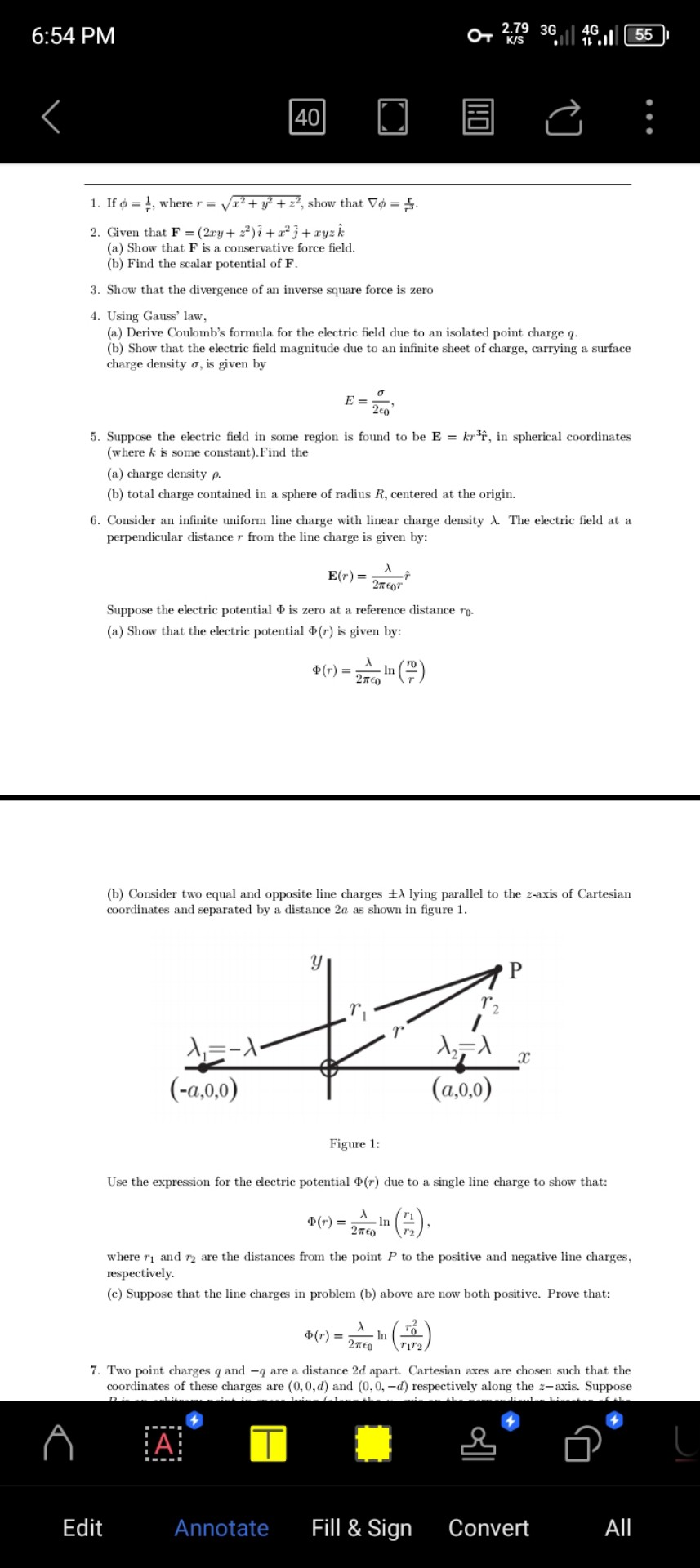
(b) Consider two equal and opposite line charges \( \pm \lambda \) lying parallel to the \( z \)-axis of Cartesian coordinates and separated by a distance \( 2 a \) as shown in figure 1 .
Figure 1:
Use the expression for the electric potential \( \Phi(r) \) due to a single line charge to show that:
\[
\Phi(r)=\frac{\lambda}{2 \pi \epsilon_{0}} \ln \left(\frac{r_{1}}{r_{2}}\right),
\]
where \( r_{1} \) and \( r_{2} \) are the distances from the point \( P \) to the positive and negative line charges, respectively.
(c) Suppose that the line charges in problem (b) above are now both positive. Prove that:
\[
\Phi(r)=\frac{\lambda}{2 \pi \epsilon_{0}} \ln \left(\frac{r_{0}^{2}}{r_{1} r_{2}}\right)
\]
7. Two point charges \( q \) and \( -q \) are a distance \( 2 d \) apart. Cartesian axes are chosen such that the coordinates of these charges are \( (0,0, d) \) and \( (0,0,-d) \) respectively along the \( z \)-axis. Suppose
Edit
Annotate
Fill \& Sign
Convert
All