Concept Practice: Modularity and Garden Path Heuristics
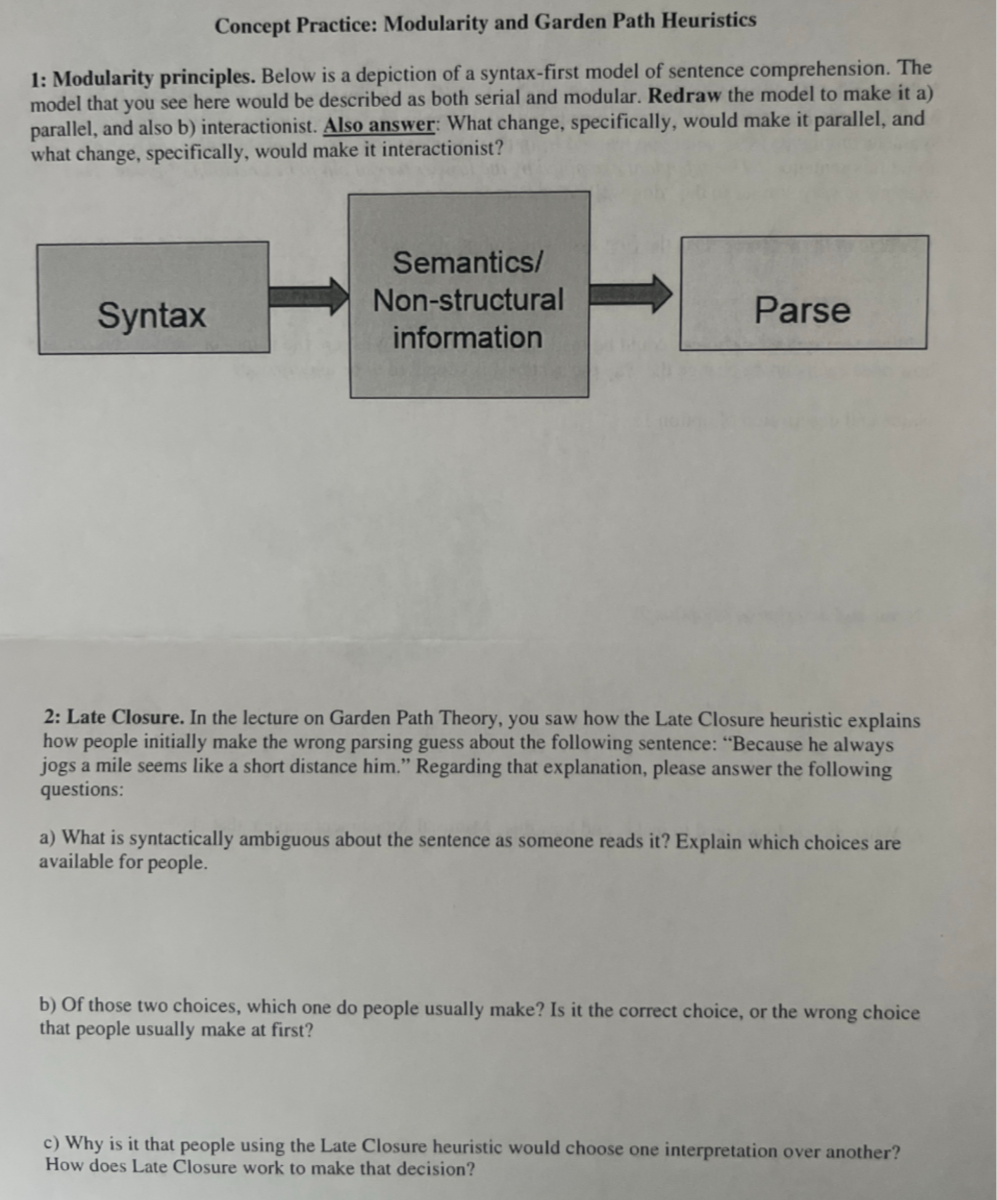
1: Modularity principles. Below is a depiction of a syntax-first model of sentence comprehension. The model that you see here would be described as both serial and modular. Redraw the model to make it a) parallel, and also b) interactionist. Also answer: What change, specifically, would make it parallel, and what change, specifically, would make it interactionist?
2: Late Closure. In the lecture on Garden Path Theory, you saw how the Late Closure heuristic explains how people initially make the wrong parsing guess about the following sentence: "Because he always jogs a mile seems like a short distance him." Regarding that explanation, please answer the following questions:
a) What is syntactically ambiguous about the sentence as someone reads it? Explain which choices are available for people.
b) Of those two choices, which one do people usually make? Is it the correct choice, or the wrong choice that people usually make at first?
c) Why is it that people using the Late Closure heuristic would choose one interpretation over another? How does Late Closure work to make that decision?