2) Let \( X \sim \operatorname{Poisson}(\theta), Y \sim \operatorname{Poisson}(\lambda) \), independent.
a. Find the distribution of \( X+Y \)
b. Show that the distribution of \( Y \mid X+Y \) binomial with success probability \( \left(\frac{\lambda}{\lambda+\theta}\right) \)
3) Let \( X \) and \( Y \) be independent, standard normal random variables. Consider the transformation
\[
U=X+Y \text { and } V=X-Y
\]
Show that the joint density of \( \mathrm{U} \) and \( \mathrm{V} \) is:
\[
f_{U, V}(u, v)=\left(\frac{1}{\sqrt{2 \pi} \sqrt{2}} e^{-\frac{u^{2}}{4}}\right)\left(\frac{1}{\sqrt{2 \pi} \sqrt{2}} e^{-\frac{v^{2}}{4}}\right)
\]
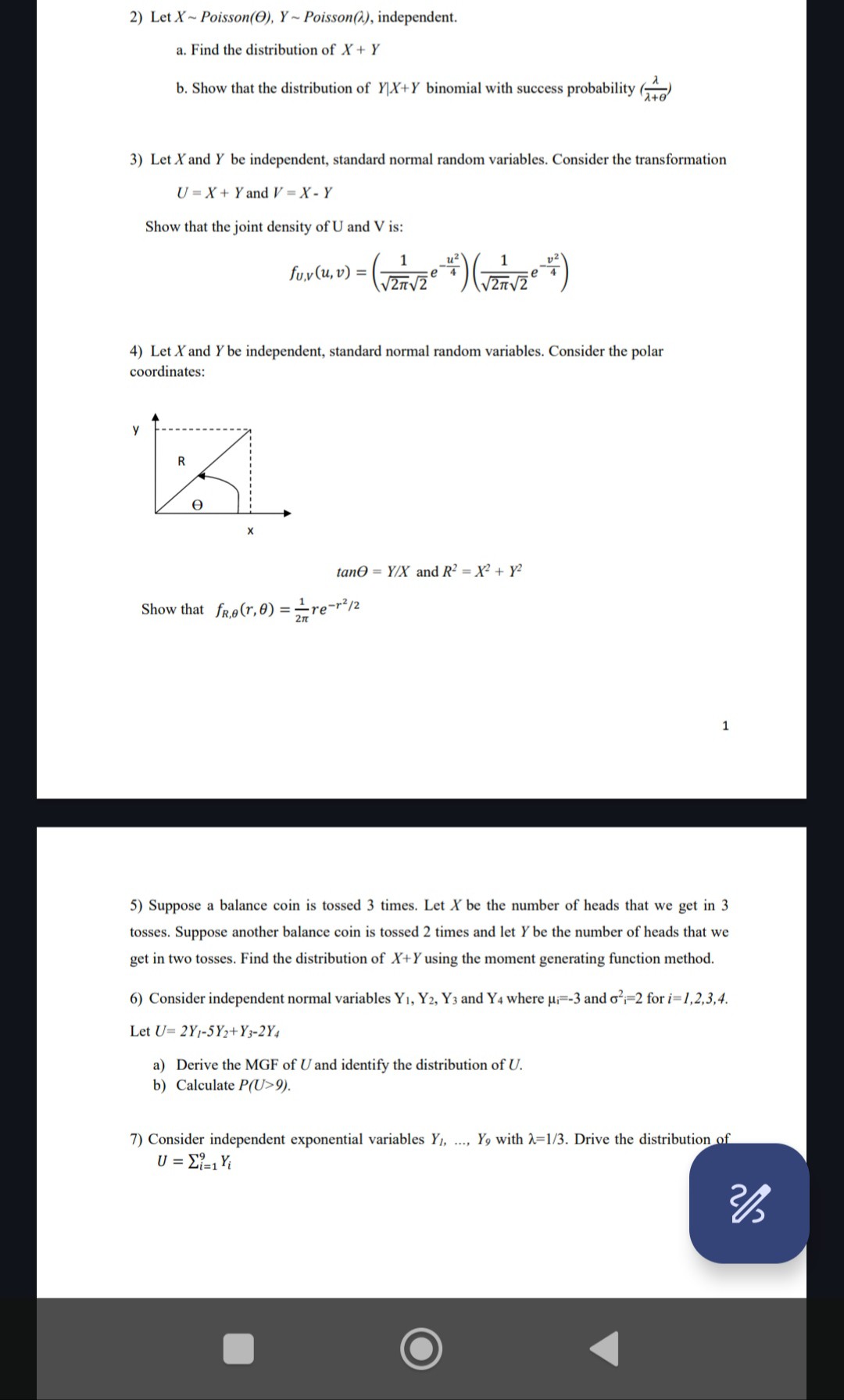
4) Let \( X \) and \( Y \) be independent, standard normal random variables. Consider the polar coordinates:
\[
\tan \Theta=Y / X \text { and } R^{2}=X^{2}+Y^{2}
\]
Show that \( f_{R, \theta}(r, \theta)=\frac{1}{2 \pi} r e^{-r^{2} / 2} \)
1
5) Suppose a balance coin is tossed 3 times. Let \( X \) be the number of heads that we get in 3 tosses. Suppose another balance coin is tossed 2 times and let \( Y \) be the number of heads that we get in two tosses. Find the distribution of \( X+Y \) using the moment generating function method.
6) Consider independent normal variables \( \mathrm{Y}_{1}, \mathrm{Y}_{2}, \mathrm{Y}_{3} \) and \( \mathrm{Y}_{4} \) where \( \mu_{\mathrm{i}}=-3 \) and \( \sigma^{2}{ }_{\mathrm{i}}=2 \) for \( i=1,2,3,4 \).
Let \( U=2 Y_{I}-5 Y_{2}+Y_{3}-2 Y_{4} \)
a) Derive the MGF of \( U \) and identify the distribution of \( U \).
b) Calculate \( P(U>9) \).
7) Consider independent exponential variables \( Y_{l}, \ldots, Y_{9} \) with \( \lambda=1 / 3 \). Drive the distribution of \( U=\sum_{i=1}^{9} Y_{i} \)