Ace - AI Tutor
Ask Our Educators
Textbooks
My Library
Flashcards
Scribe - AI Notes
Notes & Exams
Download App
Sharon Smith

Sharon S.

Divider

Questions asked

ANSWERED

Consider the following reaction: 2SO2(g) + O2(g) -> 2SO3(g) Part A If 280.1 mL of SO2 is allowed to react with 165.5 mL of O2 (both measured at 328 K and 51.3 mmHg ), what is the limiting reactant? SO2 O2 Part B What is the theoretical yield of SO3? nSO3 =

View Answer
divider
ANSWERED

The emission of NO2 by fossil fuel combustion can be prevented by injecting gaseous urea into the combustion mixture. The urea reduces NO (which oxidizes in air to form NO2) according to the following reaction: 2CO(NH2)2(g) + 4 NO(g) + O2(g) -> 4N2(g) + 2CO2(g) + 4 H2O(g) Suppose that the exhaust stream of an automobile has a flow rate of 2.70 L/s at 653 K and contains a partial pressure of NO of 10.0 torr. Part A What total mass of urea is necessary to react completely with the NO formed during 7.2 hours of driving? Express your answer using two significant figures.

View Answer
divider
ANSWERED

The air in a bicycle tire is bubbled through water and collected at 25 °C. If the total volume of gas collected is 5.65 L at a temperature of 25 °C and a pressure of 733 torr, how many moles of gas was in the bicycle tire? Express your answer in moles to three significant figures.

View Answer
divider
ANSWERED

A gaseous hydrogen- and carbon-containing compound is decomposed and found to contain 81.68% carbon and 18.32% hydrogen by mass. The mass of 158 mL of the gas, measured at 556 mmHg and 25 °C, is 0.208 g. Part A What is the molecular formula of the compound? Express your answer as a chemical formula.

View Answer
divider
ANSWERED

A quantity of CO gas occupies a volume of 0.69 L at 1.1 atm and 305 K. The pressure of the gas is lowered and its temperature is raised until its volume is 4.8 L. Find the density of the CO under the new conditions. Express your answer to two significant figures and include the appropriate units.

View Answer
divider
ANSWERED

Consider the following table: egin{tabular}{|c|c|c|c|c|c|c|} hline x & 0 & 4 & 8 & 12 & 16 & 20 \ hline f(x) & 56 & 55 & 52 & 46 & 33 & 7 \ hline end{tabular} Use this to estimate the integral: (int_{0}^{20} f(x) dx approx)

View Answer
divider
ANSWERED

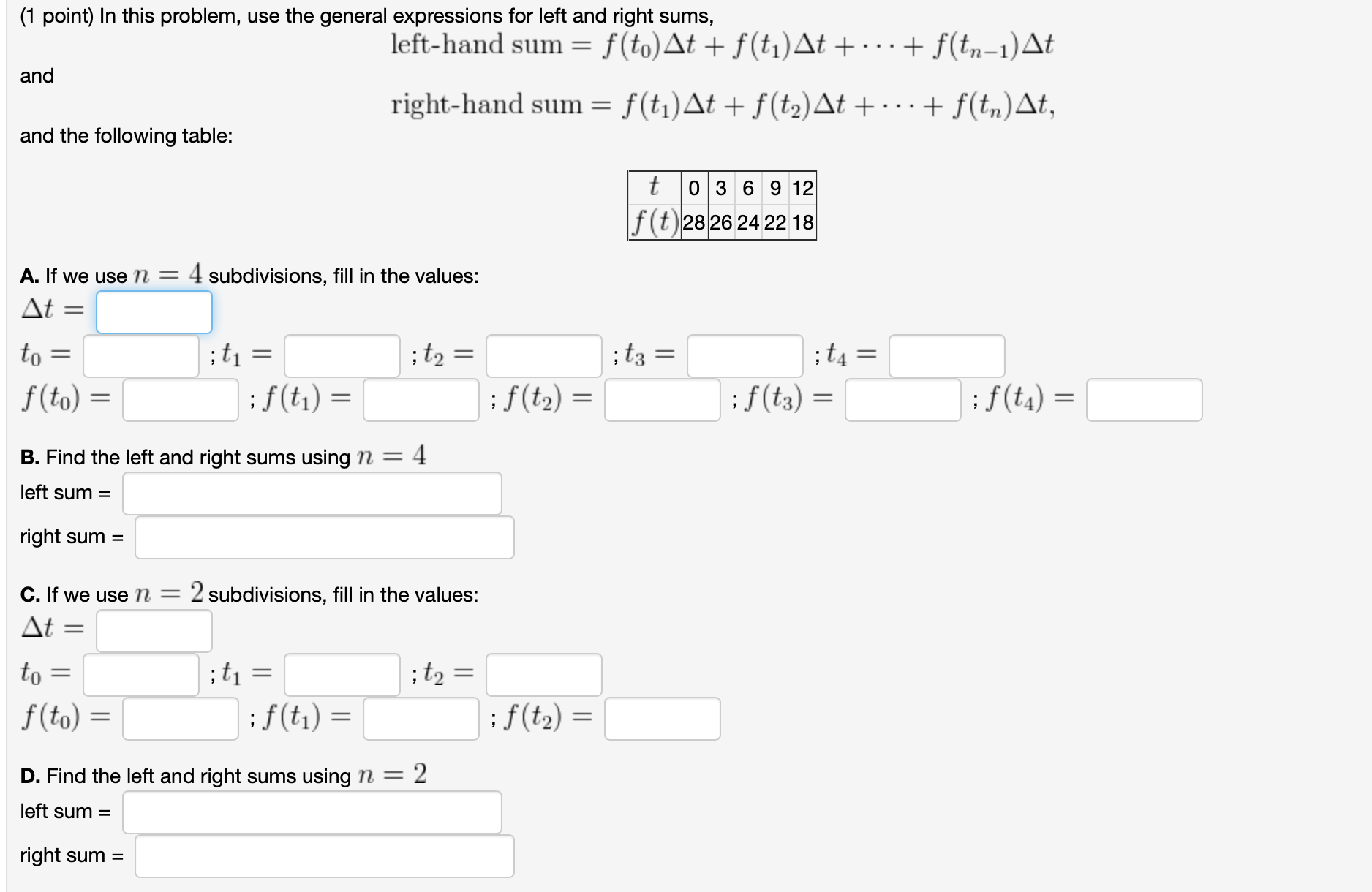
(1 point) In this problem, use the general expressions for left and right sums, left-hand sum = f(t_0)?t + f(t_1)?t + ... + f(t_{n-1})?t and right-hand sum = f(t_1)?t + f(t_2)?t + ... + f(t_n)?t, and the following table: t: 0, 3, 6, 9, 12 f(t): 28, 26, 24, 22, 18 A. If we use n = 4 subdivisions, fill in the values: ?t = t_0 = ; t_1 = ; t_2 = ; t_3 = ; t_4 = f(t_0) = ; f(t_1) = ; f(t_2) = ; f(t_3) = ; f(t_4) = B. Find the left and right sums using n = 4 left sum = right sum = C. If we use n = 2 subdivisions, fill in the values: ?t = t_0 = ; t_1 = ; t_2 = f(t_0) = ; f(t_1) = ; f(t_2) = D. Find the left and right sums using n = 2 left sum = right sum =
View Answer
divider
ANSWERED

Write the sum -3 + 5 - 7 + 9 - 11 + 13 - 15 + 17 - 19 + 21 using sigma notation. The form of your answer will depend on your choice of the lower limit of summation.

View Answer
divider
ANSWERED

Find a function f(k) such that 1 + 2 + ... + 40 = sum_{k=1}^{40} f(k). f(k) =

View Answer
divider
ANSWERED

A car initially going 63 ft/sec brakes at a constant rate (constant negative acceleration), coming to a stop in 4 seconds. Graph the velocity for t=0 to t=4. How far does the car travel before stopping? distance = (include units) How far does the car travel before stopping if its initial velocity is doubled, but it brakes at the same constant rate? distance = (include units)

View Answer
divider