Ace - AI Tutor
Ask Our Educators
Textbooks
My Library
Flashcards
Scribe - AI Notes
Notes & Exams
Download App
Beatrice Chiminelli

Beatrice C.

Divider

Questions asked

ANSWERED

Qudsiya Anis verified

Numerade educator

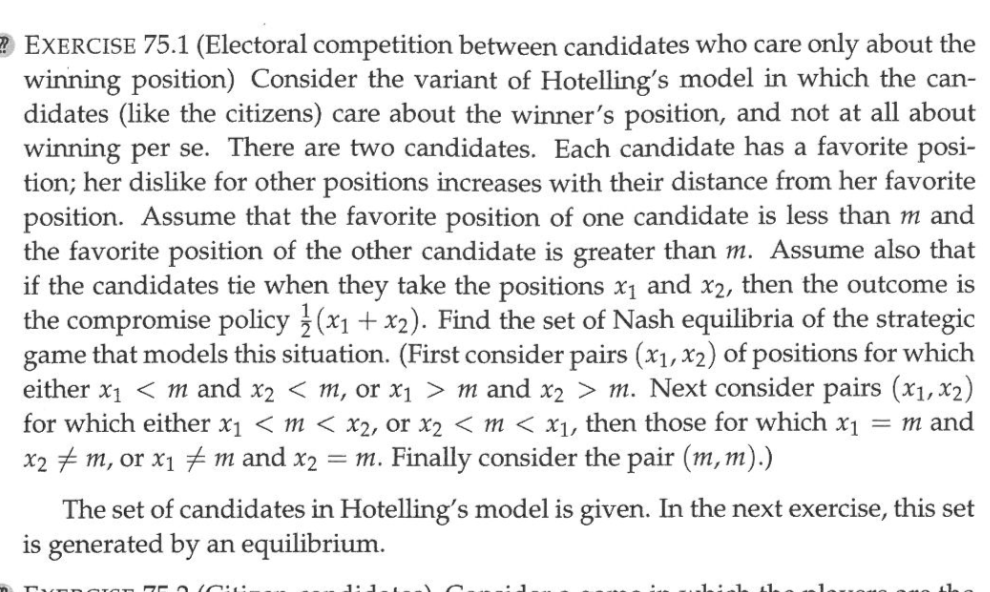
(Electoral competition between candidates who care only about the winning position) Consider the variant of Hotelling's model in which the candidates (like the citizens) care about the winner's position, and not at all about winning per se. There are two candidates. Each candidate has a favorite position; her dislike for other positions increases with their distance from her favorite position. Assume that the favorite position of one candidate is less than m and the favorite position of the other candidate is greater than m. Assume also that if the candidates tie when they take the positions x1 and x2, then the outcome is the compromise policy 1/2(x1 + x2). Find the set of Nash equilibria of the strategic game that models this situation. (First consider pairs (x1, x2) of positions for which either x1 < m and x2 < m, or x1 > m and x2 > m. Next consider pairs (x1, x2) for which either x1 < m < x2, or x2 < m < x1, then those for which x1 = m and x2 ? m, or x1 ? m and x2 = m. Finally consider the pair (m, m).) The set of candidates in Hotelling's model is given. In the next exercise, this set is generated by an equilibrium.
View Answer
divider
ANSWERED

Qudsiya Anis verified

Numerade educator

(Electoral competition between candidates who care only about the winning position) Consider the variant of Hotelling's model in which the candidates (like the citizens) care about the winner's position, and not at all about winning per se. There are two candidates. Each candidate has a favorite position; her dislike for other positions increases with their distance from her favorite position. Assume that the favorite position of one candidate is less than m and the favorite position of the other candidate is greater than m. Assume also that if the candidates tie when they take the positions x1 and x2, then the outcome is the compromise policy 1/2(x1 + x2). Find the set of Nash equilibria of the strategic game that models this situation. (First consider pairs (x1, x2) of positions for which either x1 < m and x2 < m, or x1 > m and x2 > m. Next consider pairs (x1, x2) for which either x1 < m < x2, or x2 < m < x1, then those for which x1 = m and x2 ? m, or x1 ? m and x2 = m. Finally consider the pair (m, m).) The set of candidates in Hotelling's model is given. In the next exercise, this set is generated by an equilibrium.

View Answer
divider