Ace - AI Tutor
Ask Our Educators
Textbooks
My Library
Flashcards
Scribe - AI Notes
Notes & Exams
Download App
beatriz herrero

beatriz h.

Divider

Questions asked

BEST MATCH

Opportunity Cost of Capital Consider a portfolio manager whose mission is “to maximize annual returns through investments in the bonds of Industrial-Property REITs.” Which is the best opportunity cost investment for this manager?

View Answer
divider
BEST MATCH

The following statement is to be used in answering questions 1 - 4. Company A desires a floating-rate, long-term loan. A has access to floating interest rate funds at a margin of 1% over LIBOR. Its direct borrowing cost is 8% in the fixed-rate bond market. In contrast, Company B, which prefers a fixed-rate bond, has access to fixed-rate funds in the bond market at 10% and floating-rate funds at LIBOR + 1.5%. Assume there is no banking intermediary and all flows are in USD. What is the maximum net cost savings either party can enjoy if costs are not evenly split? 1% • 1.5% 0% 2%

View Answer
divider
BEST MATCH

Which algal toxin is associated with the largest confirmed human fatalities?

View Answer
divider
BEST MATCH

4. Patty won an academic aware from a local foundation and was given $8,000. Her plan it to put the money in a savings account that will earn 6% interest, compounded quarterly. How much money will Patty have after 15 years? (Round your answer to the penny.)

View Answer
divider
BEST MATCH

You need to run an experiment that requires water at 35°C, but you only have access to water at room temperature. Find: • The pressure change required to heat the water while keeping its volume constant. • The volume change required to heat the water while keeping it at constant pressure. • Which of these two processes would you run? And why? The isothermal compressibility of water at room temperature is $k_T = 5.0 \times 10^{-5} atm^{-1}$, and its isobaric thermal expansion is $\beta = 2.1 \times 10^{-4} K^{-1}$. You can consider the two to be constant within the temperature range of this problem.

View Answer
divider
BEST MATCH

Which medical savings plan is "use it or lose it" in regards to rollover funds? Group of answer choices HSA HRA FSA FMLA

View Answer
divider
BEST MATCH

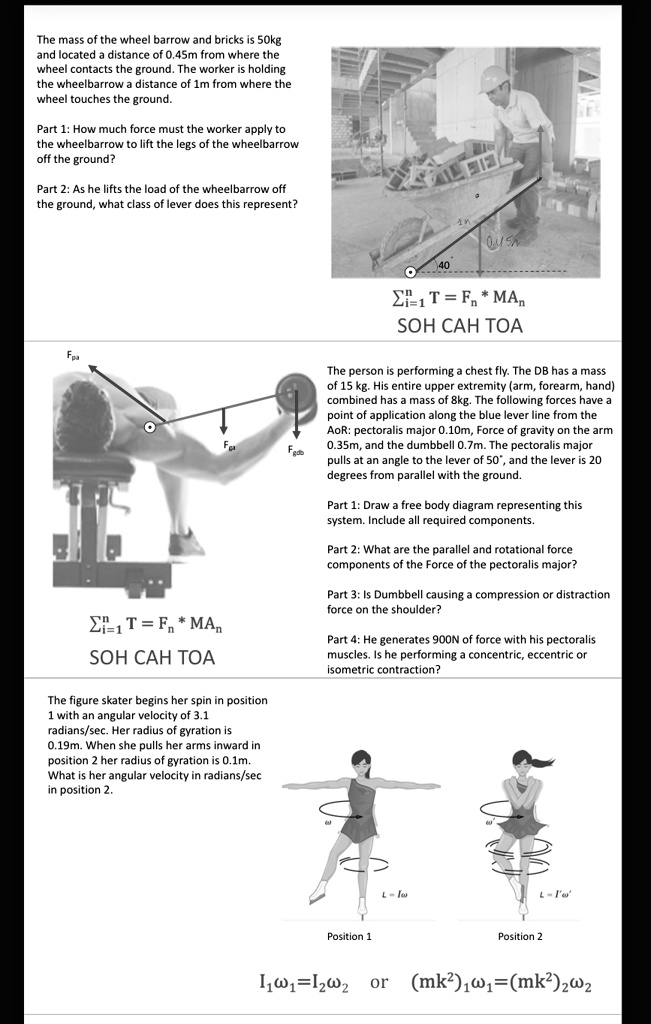
The mass of the wheel barrow and bricks is 50kg and located a distance of 0.45m from where the wheel contacts the ground. The worker is holding the wheelbarrow a distance of 1m from where the wheel touches the ground. Part 1: How much force must the worker apply to the wheelbarrow to lift the legs of the wheelbarrow off the ground? Part 2: As he lifts the load of the wheelbarrow off the ground, what class of lever does this represent? SOH CAH TOA دUП ЧAП IUA The person is performing a chest fly. The DB has a mass of 15kg. His entire upper extremity (arm, forearm, hand) combined has a mass of 8kg. The following forces have a point of application along the blue lever line from the AoR: pectoralis major 0.10m, Force of gravity on the arm 0.35m, and the dumbbell 0.7m. The pectoralis major pulls at an angle to the lever of 50deg , and the lever is 20 degrees from parallel with the ground. Part 1: Draw a free body diagram representing this system. Include all required components. Part 2: What are the parallel and rotational force components of the Force of the pectoralis major? Part 3: Is Dumbbell causing a compression or distraction force on the shoulder? Part 4: He generates 900N of force with his pectoralis muscles. Is he performing a concentric, eccentric or isometric contraction? The figure skater begins her spin in position 1 with an angular velocity of 3.1 radians/sec. Her radius of gyration is 0.19m. When she pulls her arms inward in position 2 her radius of gyration is 0.1m. What is her angular velocity in radians/sec in position 2 . I_(1)omega _(1)=I_(2)omega _(2) or ,(mk^(2))_(1)omega _(1)=(mk^(2))_(2)omega _(2) The mass of the wheel barrow and bricks is 50kg and located a distance of 0.45m from where the wheel contacts the ground. The worker is holding the wheelbarrow a distance of 1m from where the wheel touches the ground. Part 1: How much force must the worker apply to the wheelbarrow to lift the legs of the wheelbarrow off the ground? Part 2: As he lifts the load of the wheelbarrow off the ground, what class of lever does this represent? Ei=1T=F,*MAn SOH CAH TOA Fps The person is performing a chest fly. The DB has a mass of 15 kg. His entire upper extremity (arm, forearm, hand) combined has a mass of 8kg. The following forces have a point of application along the blue lever line from the AoR: pectoralis major 0.10m, Force of gravity on the arm 0.35m, and the dumbbell 0.7m. The pectoralis major pulls at an angle to the lever of 50, and the lever is 20 degrees from parallel with the ground Part 1:Draw a free body diagram representing this system. Include all required components. Part 2: What are the parallel and rotational force components of the Force of the pectoralis major? Part 3: Is Dumbbell causing a compression or distraction force on the shoulder? Ef=T=F*MAn SOH CAH TOA Part 4: He generates 900N of force with his pectoralis muscles. Is he performing a concentric, eccentric or isometric contraction? The figure skater begins her spin in position 1with an angular velocity of 3.1 radians/sec. Her radius of gyration is 0.19m. When she pulls her arms inward in position 2 her radius of gyration is 0.1m. What is her angular velocity in radians/sec in position 2. L =I Position 1 Position 2 IW1=I2W20r (mk2)W=(mk2)2W2
View Answer
divider
BEST MATCH

Describe the sampling distribution of \hat{p}. Assume the size of the population is 30,000. n = 700, p = 0.7 Choose the phrase that best describes the shape of the sampling distribution of \hat{p} below. A. Not normal because n ? 0.05N and np(1-p) ? 10. B. Approximately normal because n ? 0.05N and np(1-p) ? 10. C. Approximately normal because n ? 0.05N and np(1-p) < 10. D. Not normal because n ? 0.05N and np(1-p) < 10. Determine the mean of the sampling distribution of \hat{p}. \mu_{\hat{p}} = (Round to one decimal place as needed.) Determine the standard deviation of the sampling distribution of \hat{p}. \sigma_{\hat{p}} = (Round to three decimal places as needed.)

View Answer
divider
BEST MATCH

2. Let X = (x1, x2,..., x6) be a Markov Random Field, see Figure 1. Assume xi ? {?1,1}, 1 ? i ? 6. and the probability of X is \begin{equation} P(X) = \frac{1}{Z} \left( \frac{1}{1 + |x_1 - x_2|} \right) |1 - x_2x_3|e^{-x_1x_3 + x_3x_4}e^{-(x_4 - x_5)^2}e^{-(x_4 - x_6)^2}, \end{equation} where Z is the normalization constant. (a) Find all the maximal cliques. (b) Choose a site visiting order using the \"heuristic\" discussed in class. (c) Describe in words how to compute $\text{argmax}_x P(X)$ using dynamic programming. (d) Either write a Matlab code or do it manually to find $\text{argmax}_x P(X)$ using dynamic programming. Show the results for each step using tables and report the optimal X.

View Answer
divider
BEST MATCH

Problem 4 For a period $T = 1/\omega$, recall that $\ell^* = Tp$. (a) Show that when $p \ll \beta$, $T = \frac{1}{p} \sum_{i=1}^{\beta} \frac{\beta_i}{\lambda_i}$ (b) Show that when $p > \beta$, $T = \frac{\ell^*}{p - \beta}$

View Answer
divider