3. Use the cross product \(\mathbf{u} \times \mathbf{v}\) to find the acute angle between vectors \(\mathbf{u}\) and \(\mathbf{v}\), where \(\mathbf{u} = \mathbf{i} + 2\mathbf{j}\) and \(\mathbf{v} = \mathbf{i} + \mathbf{k}\). Express the answer in degrees rounded to the nearest integer.
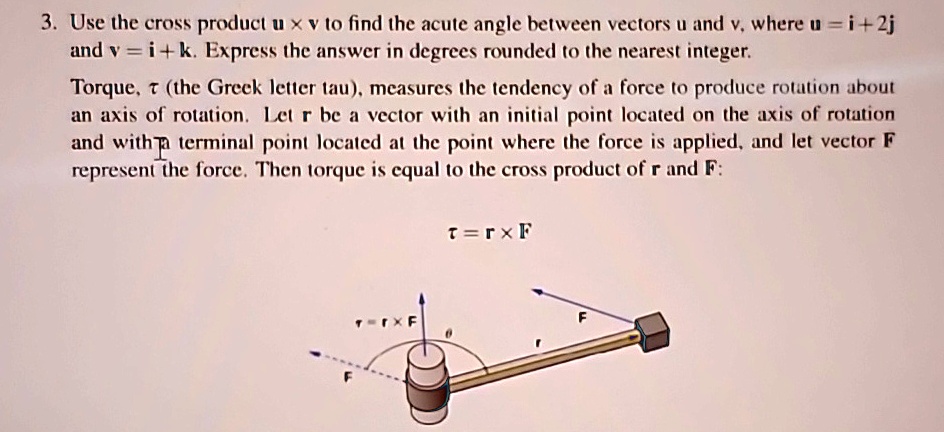
Torque, \(\tau\) (the Greek letter tau), measures the tendency of a force to produce rotation about an axis of rotation. Let \(\mathbf{r}\) be a vector with an initial point located on the axis of rotation and with a terminal point located at the point where the force is applied, and let vector \(\mathbf{F}\) represent the force. Then torque is equal to the cross product of \(\mathbf{r}\) and \(\mathbf{F}\):
\(\tau = \mathbf{r} \times \mathbf{F}\)