3.
There is a very useful generation function that related to the Legendre
polynomials:
\begin{equation}
G(u,x) = \frac{1}{\sqrt{1-2xu+u^2}} = \sum_{n=0}^{\infty}P_n(x)u^n
\end{equation}
(1)
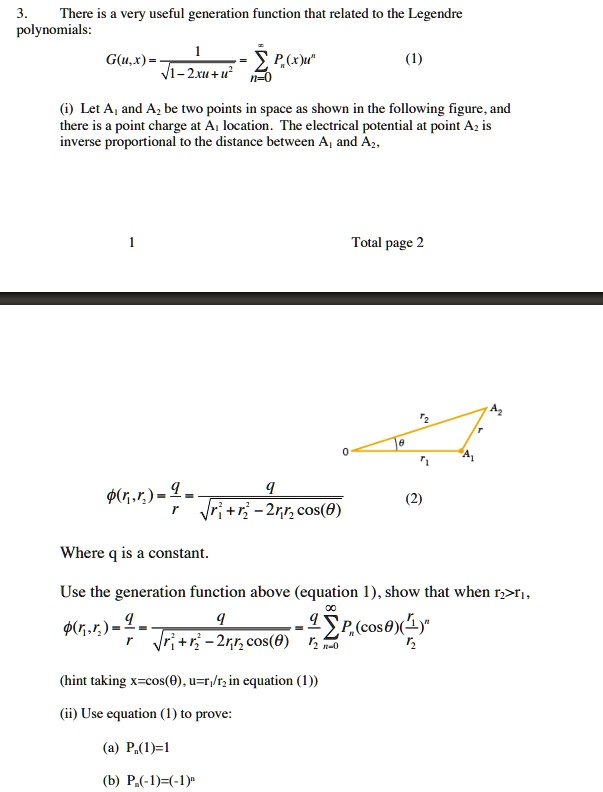
(i) Let A? and A? be two points in space as shown in the following figure, and
there is a point charge at A? location. The electrical potential at point A? is
inverse proportional to the distance between A? and A?,
1
Total page 2
$A_2$
$r_2$
$\theta$
0
$r_1$
$A_1$
\begin{equation}
\phi(r_1,r_2) = \frac{q}{r} = \frac{q}{\sqrt{r_1^2+r_2^2-2r_1r_2\cos(\theta)}}
\end{equation}
(2)
Where q is a constant.
Use the generation function above (equation 1), show that when r?>r?,
\begin{equation}
\phi(r_1,r_2) = \frac{q}{r} = \frac{q}{\sqrt{r_1^2+r_2^2-2r_1r_2\cos(\theta)}} = \frac{q}{r_2}\sum_{n=0}^{\infty}P_n(cos\theta)(\frac{r_1}{r_2})^n
\end{equation}
(hint taking x=cos(?), u=r?/r? in equation (1))
(ii) Use equation (1) to prove:
(a) P?(1)=1
(b) P?(-1)=(-1)?