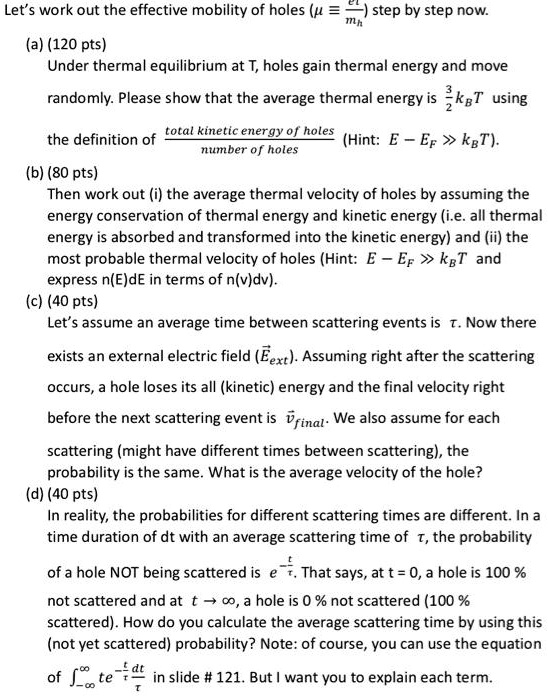
mh Let's work out the effective mobility of holes (μ = step by step now. (a) (120 pts) Under thermal equilibrium at T, holes gain thermal energy and move randomly. Please show that the average thermal energy is kBT using total kinetic energy of holes number of holes (Hint: EEF » KBT). the definition of (b) (80 pts) Then work out (i) the average thermal velocity of holes by assuming the energy conservation of thermal energy and kinetic energy (i.e. all thermal energy is absorbed and transformed into the kinetic energy) and (ii) the most probable thermal velocity of holes (Hint: E - Ep» kBT and express n(E) dE in terms of n(v)dv). (c) (40 pts) Let's assume an average time between scattering events is T. Now there exists an external electric field (Eext). Assuming right after the scattering occurs, a hole loses its all (kinetic) energy and the final velocity right before the next scattering event is final. We also assume for each scattering (might have different times between scattering), the probability is the same. What is the average velocity of the hole? (d) (40 pts) In reality, the probabilities for different scattering times are different. In a time duration of dt with an average scattering time of T, the probability of a hole NOT being scattered ise. That says, at t = 0, a hole is 100 % not scattered and at t→∞, a hole is 0 % not scattered (100 % scattered). How do you calculate the average scattering time by using this (not yet scattered) probability? Note: of course, you can use the equation _t dt T of te in slide # 121. But I want you to explain each term.
Let's work out the effective mobility of holes(u= step by step now m
(a)(120pts) Under thermal equilibrium at T,holes gain thermal energy and move
randomly. Please show that the average thermal energy is kgT using
number of holes
(b)(80 pts) Then work out(i the average thermal velocity of holes by assuming the energy conservation of thermal energy and kinetic energy(i.e.all therma energy is absorbed and transformed into the kinetic energy) andii the most probable thermal velocity of holes(Hint:E-EF>>kgT and express n(E)dE in terms of n(v)dv) c)(40pts) Let's assume an average time between scattering events is T.Now there
exists an external electric field Eext).Assuming right after the scattering
occurs,a hole loses its all(kinetic)energy and the final velocity right
before the next scattering event isrinat. We also assume for each
scattering(might have different times between scattering),the probability is the same.What is the average velocity of the hole? d40 pts) In reality the probabilities for different scattering times are different.In a time duration of dt with an average scattering time of T,the probability
of a hole NOT being scattered is e .That says,at t=0,a hole is 100 %
not scattered and at t- co,a hole is 0%not scattered100%
scattered.How do you calculate the average scattering time by using this
(not yet scattered) probability?Note:of course,you can use the equation
of
p te in slide #121.But I want you to explain each term.