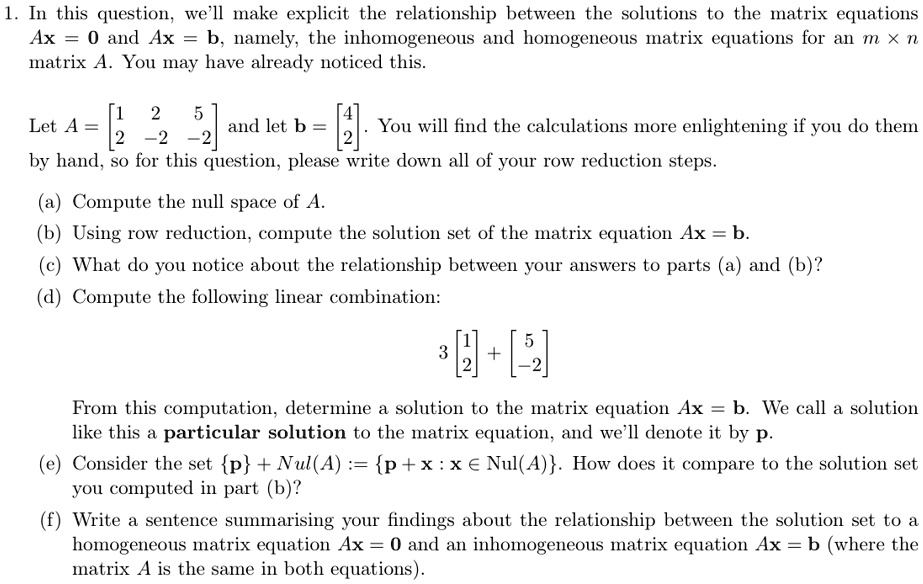
1. In this question, we'll make explicit the relationship between the solutions to the matrix equations
Ax = 0 and Ax = b, namely, the inhomogeneous and homogeneous matrix equations for an $m \times n$
matrix A. You may have already noticed this.
Let $A = \begin{bmatrix} 1 & 2 & 5\\ 2 & -2 & -2 \end{bmatrix}$ and let $b = \begin{bmatrix} 4\\ 2 \end{bmatrix}$. You will find the calculations more enlightening if you do them
by hand, so for this question, please write down all of your row reduction steps.
(a) Compute the null space of A.
(b) Using row reduction, compute the solution set of the matrix equation Ax = b.
(c) What do you notice about the relationship between your answers to parts (a) and (b)?
(d) Compute the following linear combination:
$3\begin{bmatrix} 1\\ 2 \end{bmatrix} + \begin{bmatrix} 5\\ -2 \end{bmatrix}$
From this computation, determine a solution to the matrix equation Ax = b. We call a solution
like this a particular solution to the matrix equation, and we'll denote it by p.
(e) Consider the set \{p\} + Nul(A) := \{p + x : x \in Nul(A)\}. How does it compare to the solution set
you computed in part (b)?
(f) Write a sentence summarising your findings about the relationship between the solution set to a
homogeneous matrix equation Ax = 0 and an inhomogeneous matrix equation Ax = b (where the
matrix A is the same in both equations).