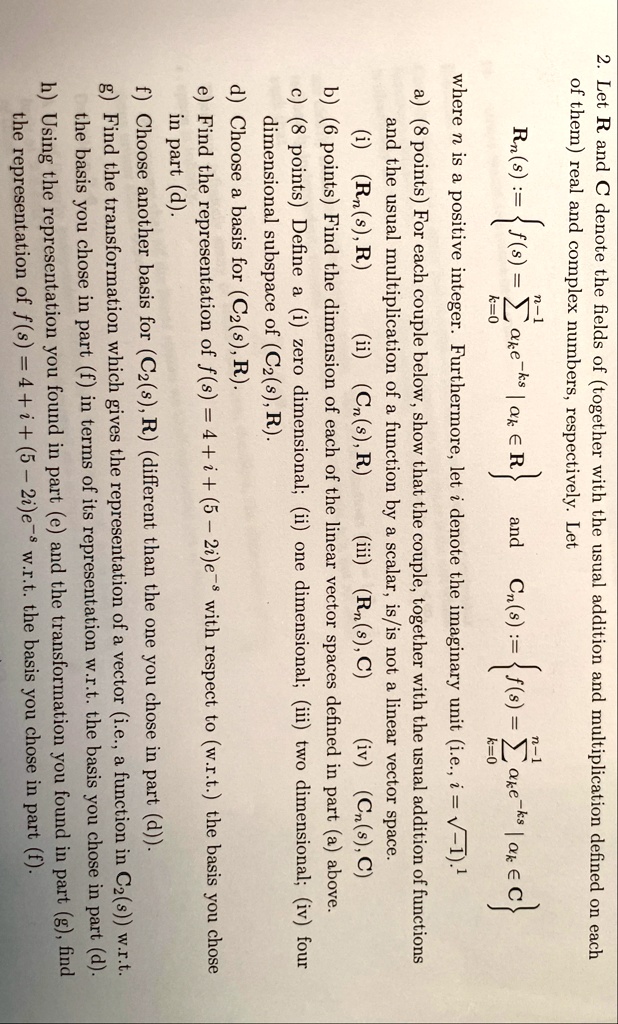
2. Let R and C denote the fields of (together with the usual addition and multiplication defined on each of them) real and complex numbers, respectively. Let
$$R_n(s) := \left\{f(s) = \sum_{k=0}^{n-1} \alpha_k e^{-ks} \mid \alpha_k \in R\right\}$$
and
$$C_n(s) := \left\{f(s) = \sum_{k=0}^{n-1} \alpha_k e^{-ks} \mid \alpha_k \in C\right\}$$
where n is a positive integer. Furthermore, let i denote the imaginary unit (i.e., $$i = \sqrt{-1}$$).
a) (8 points) For each couple below, show that the couple, together with the usual addition of functions and the usual multiplication of a function by a scalar, is/is not a linear vector space.
(i) $$(R_n(s), R)$$
(ii) $$(C_n(s), R)$$
(iii) $$(R_n(s), C)$$
(iv) $$(C_n(s), C)$$
b) (6 points) Find the dimension of each of the linear vector spaces defined in part (a) above.
c) (8 points) Define a (i) zero dimensional; (ii) one dimensional; (iii) two dimensional; (iv) four dimensional subspace of $$(C_2(s), R)$$.
d) Choose a basis for $$(C_2(s), R)$$.
e) Find the representation of $$f(s)$$ in part (d).
f) Choose another basis for $$(C_2(s), R)$$ (different than the one you chose in part (d)).
g) Find the transformation which gives the representation of a vector (i.e., a function in $$C_2(s)$$) w.r.t. the basis you chose in part (f) in terms of its representation w.r.t. the basis you chose in part (d).
h) Using the representation you found in part (e) and the transformation you found in part (g), find the representation of $$f(s) = 4 + i + (5 - 2i)e^{-s}$$ w.r.t. the basis you chose in part (f).