Problem 3
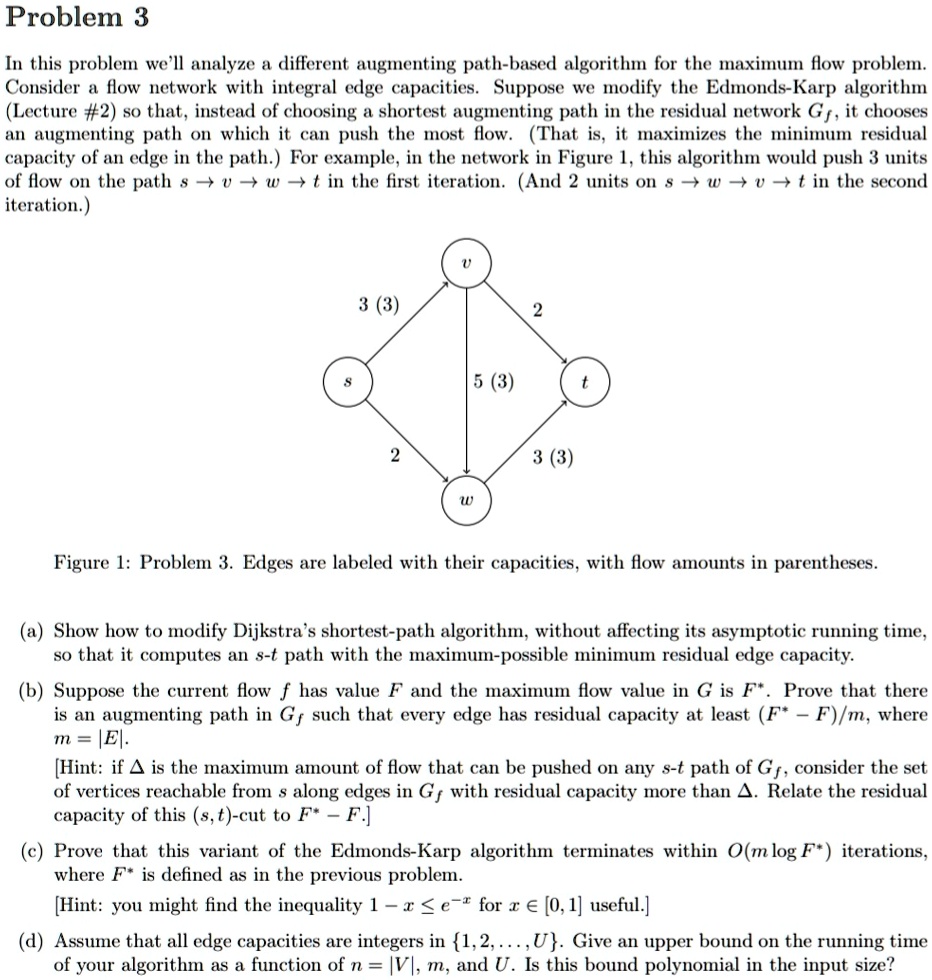
In this problem we'll analyze a different augmenting path-based algorithm for the maximum flow problem. Consider a flow network with integral edge capacities. Suppose we modify the Edmonds-Karp algorithm Lecture #2 so that,instead of choosing a shortest augmenting path in the residual network Gf,it chooses an augmenting path on which it can push the most flow. (That is, it maximizes the minimum residual capacity of an edge in the path.) For example,in the network in Figure 1,this algorithm would push 3 units of flow on the path s - w- t in the first iteration.(And 2 units on s w t in the second iteration.)
3 (3)
2
5(3)
3 (3)
w
Figure l: Problem 3. Edges are labeled with their capacities.with fiow amounts in parentheses
a Show how to modify Dijkstra's shortest-path algorithm,without affecting its asymptotic running time so that it computes an s-t path with the maximum-possible minimum residual edge capacity
(b Suppose the current flow f has value F and the maximum flow value in G is F*. Prove that there is an augmenting path in Gf such that every edge has residual capacity at least (F* - F/m,where m=|E|. [Hint: if is the maximum amount of flow that can be pushed on any s-t path of G, consider the set of vertices reachable from s along edges in Gf with residual capacity more than . Relate the residual capacity of this (s,t)-cut to F* - F.]
(c) Prove that this variant of the Edmonds-Karp algorithm terminates within O(m log F*) iterations, where F* is defined as in the previous problem.
[Hint: you might find the inequality 1 - e- for [0,1] useful.]
d Assume that all edge capacities are integers in {1,2,.,U}.Give an upper bound on the running time of your algorithm as a function of n =V, m, and U.Is this bound polynomial in the input size?