Ace - AI Tutor
Ask Our Educators
Textbooks
My Library
Flashcards
Scribe - AI Notes
Notes & Exams
Download App
belinda russo

belinda r.

Divider

Questions asked

BEST MATCH

A nurse is caring for a client who is in labor. Medical History Vital Signs Nurses Notes Diagnostic Results Gravida 2, Para 1 28 weeks of gestation Previous cesarean section Asthma.1300: Temperature 37.2\deg C (98.9\deg F) Heart rate 84 /min Respiratory rate 18 /min Blood pressure 108/84 mm Hg Oxygen saturation 98%Client reports increased clear vaginal leakage for the past 12 hr. Client denies cramping or contractions. Client reports fetal movement is present and unchanged. Client also reports a temporal headache for the past few hours and rates it as 2 on scale of 0 to 10. Moderate amount of clear vaginal drainage noted on client's perineal pad. Bilateral lower extremity non-pitting edema noted. Deep tendon reflexes 2+. Fundal height at 30 cm External fetal monitor applied. 1400: Fetal heart rate Category I at 150/min. Moderate variability. No accelerations or decelerations noted. No contractions noted. After reviewing the information provided in the client's medical record, which of the following complications should the nurse identify that the client is at risk of developing? Complete the following sentence by using the list of options. The client is at great risk for developing chorioamnionitis as evidenced by the client's leakage of vaginal fluid .Speculum examination by provider: Cervix appears closed. Nitrazine test: blue-gray, pH 7.0, positive for rupture of membranes Microscopic examination of vaginal fluid: Crystalline ferning pattern

View Answer
divider
BEST MATCH

Question 5 Given the function f(x)=3x^(3)-3. Find the average rate of change of f from x=-2 to x=2 Give your answer as an integer or reduced fraction. Average rate of change: Question 5 Given the function f() =33 -- 3. Find the average rate of change of f from = -2 to =2 Give your answer as an integer or reduced fraction. Average rate of change:

View Answer
divider
BEST MATCH

A beaker contains 75 mL of H2O (water) and 25 mL of a solution of HCl. If 10 mL of the HCl solution is added to 27.43 mL of 0.095 M NaOH to make the solution neutral, then what was the concentration of the original NaCl solution?

View Answer
divider
BEST MATCH

Question 3. If two resistors with resistances \textit{x} ohms and \textit{y} ohms are connected in parallel, then their total resistance \textit{R} satisfies the equation: \begin{equation*} \frac{1}{R} = \frac{1}{x} + \frac{1}{y} \end{equation*} 1) From this equation make \textit{R} the subject. 2) Find the differential of the function \textit{R(x, y)}. 3) The resistances are measured as \textit{x} = 10 ohms and \textit{y} = 40 ohms, with a possible error of 2% in each case. Use the differential to estimate the maximum error in the calculated value of \textit{R}.

View Answer
divider
BEST MATCH

Compounds A and B are isomers and are formed by radical monochlorination of compound C (C$_3$H$_6$Cl$_2$). The $^1$H NMR spectra of A and B are provided: the signals in A are singlets, and the splitting patterns are given for B. Draw the structures of A, B, and C. $^1$H NMR spectrum of A $^1$H NMR spectrum of B doublet doublet multiplet

View Answer
divider
BEST MATCH

Warm-Up 8-3 (book/static) Question Help The expected annual returns are 15% for investment 1 and 12% for investment 2. The standard deviation of the first investment's return is 10%; the second investment's return has a standard deviation of 5%. Which investment is less risky based solely on standard deviation? Which investment is less risky based on coefficient of variation? Which is a better measure given that the expected returns of the two investments are not the same? Which investment is less risky based solely on standard deviation? (Select from the drop-down menus) is less risky because its standard deviation is

View Answer
divider
BEST MATCH

Combustor Exhaust 5-A) Propane is a typical fuel for rural buildings. Assume a water heater burns propane gas with 20% excess air to ensure complete combustion. The fuel and (dry) air enter at standard pressure and temperature (1 ATM, 298 K). The temperature of the exhaust gases is kept high (450 K) to avoid condensation and corrosion in the heat exchanger and in the metal exhaust stack. The steady-state heat transfer rate from the combustion products to the water is 20,000 kJ/hr. FIND the air/fuel ratio with 20% excess air (kg-DA/kg-fuel) = Cold Water In Hot Water Out No CV external Wcv or q Fuel In Dry Air In (ANS-20/1) Solve for 1 kmol fuel and finish the table for the composition of the exhaust gas. Find Mmix & Rmix Mi Ni y$_i$ = N$_i$/N$_{mix}$ m$_i$ = N$_i$ M$_i$ m$_{fi}$ = m$_i$/m$_{mix}$ (kg/kmol) (kmol) mol fraction (kg) mass fraction AS CO2 44.01 3 H2O 18.02 4 m$_{CO2}$ 132.03 O2 32.00 1 m$_{H2O}$ 72.08 N2 28.01 m$_{O2}$ 32.00 Total Mixture 1.000 M$_{mix}$ (kg/kmol) = 1.000 FIND H$_2$O vapor pressure ($p_v$) and dew point (condensation) temperature of the exhaust, T$_{DP}$ = °C FIND the mass flowrates of fuel & air required, M$_{FUEL}$ = (kg/hr), m$_{AIR}$ = (kg/hr) FIND the combustion efficiency (based on HHV) = energy utilized per kg fuel / fuel heating value = _%

View Answer
divider
BEST MATCH

Question 9 (1 point) Choose the correct sketch for the vector field F. F(x, y) = 0.3\hat{i} - 0.4\hat{j}

View Answer
divider
BEST MATCH

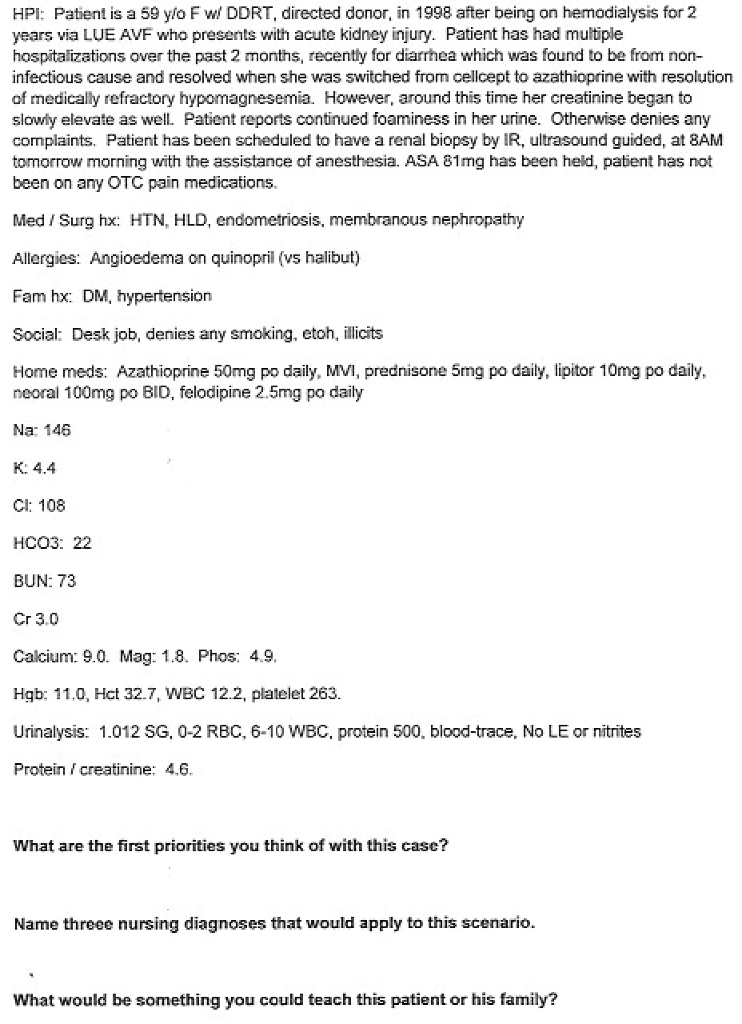
HPI Patient is a 59-year-old female with DDRT-directed donor in 1998 after being on hemodialysis for 2 years via LUE AVF who presents with acute kidney injury. The patient has had multiple hospitalizations over the past 2 months, recently for diarrhea which was found to be from a non-infectious cause and resolved when she was switched from Cellcept to azathioprine with resolution of medically refractory hypomagnesemia. However, around this time her creatinine began to slowly elevate as well. The patient reports continued foaminess in her urine. Otherwise, she denies any complaints. The patient has been scheduled to have a renal biopsy by IR, ultrasound-guided, at 8 AM tomorrow morning with the assistance of anesthesia. ASA 81mg has been held, and the patient has not been on any OTC pain medications. Med/Surg hx: HTN, HLD, endometriosis, membranous nephropathy Allergies: Angioedema on quinapril (vs halibut) Fam hx: DM, hypertension Social: Desk job, denies any smoking, alcohol, illicit drugs Home meds: Azathioprine 50mg po daily, MVI, prednisone 5mg po daily, Lipitor 10mg po daily, Neoral 100mg po BID, felodipine 2.5mg po daily Na: 146 K: 4.4 CI: 108 HCO3: 22 BUN: 73 Cl: 10 Calcium: 9.0, Mag: 1.8, Phos: 4.9 Hgb: 11.0, Hct: 32.7, WBC: 12.2, platelet: 263 Urinalysis: 1.012 SG, 0-2 RBC, 6-10 WBC, protein 500, blood-trace. No LE or nitrites Protein/creatinine: 4.6
View Answer
divider
BEST MATCH

Question Table 1 Load Power per unit, kW Quantity, unit Power Factor, p.f Essentiality A 3 4 0.85 lagging YES B 2.7 2 0.73 lagging NO C 3.2 10 0.6 lagging YES D 2.2 7 0.9 lagging YES E 6 6 Unity NO F 1.5 5 0.78 leading YES G 0.5 8 Unity YES a. Table 1 shows a partial load distribution at one of the plant in Siltronics Company. As a team of electrical technologist in MZZ Company, you are given a task to develop an UPS system as a backup supply for production line in Siltronics Company. The UPS is a 140 VDC system with 90% efficiency at full load, requiring a battery system with an end votage per bank of 126 V and end voltage per cell of 1.8 V. The UPS system should have 1 hour of backup and 8 hour of recharge time. i. Determine the overall power factor of essential loads. ii. Calculate kW/Cell (4 Marks) (3 Marks) iii. Evaluate the size of charger required for the loads given in Table 1 with no additional de loads. (3 Marks) iv. If the maximum demand of all loads is 80%, propose the size of UPS with additional 20% extra capacity. (3 Marks)

View Answer
divider