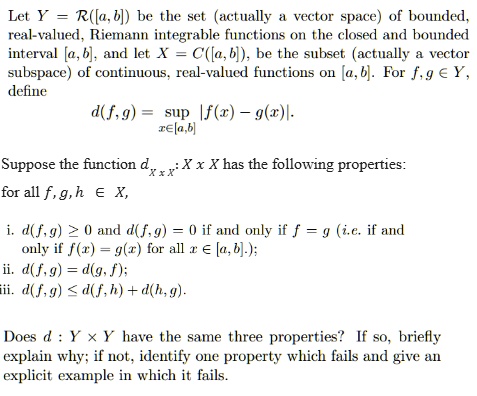
Let Y = \mathcal{R}([a, b]) be the set (actually a vector space) of bounded, real-valued, Riemann integrable functions on the closed and bounded interval [a, b], and let X = \mathcal{C}([a, b]), be the subset (actually a vector subspace) of continuous, real-valued functions on [a, b]. For $f, g \in Y$, define
$\qquad d(f, g) = \sup_{x \in [a, b]} |f(x) - g(x)|$.
Suppose the function $d_{X \times X} : X \times X$ has the following properties:
for all $f, g, h \in X$,
i. $d(f, g) \ge 0$ and $d(f, g) = 0$ if and only if $f = g$ (i.e. if and only if $f(x) = g(x)$ for all $x \in [a, b]$);
ii. $d(f, g) = d(g, f)$;
iii. $d(f, g) \le d(f, h) + d(h, g)$.
Does $d : Y \times Y$ have the same three properties? If so, briefly explain why; if not, identify one property which fails and give an explicit example in which it fails.