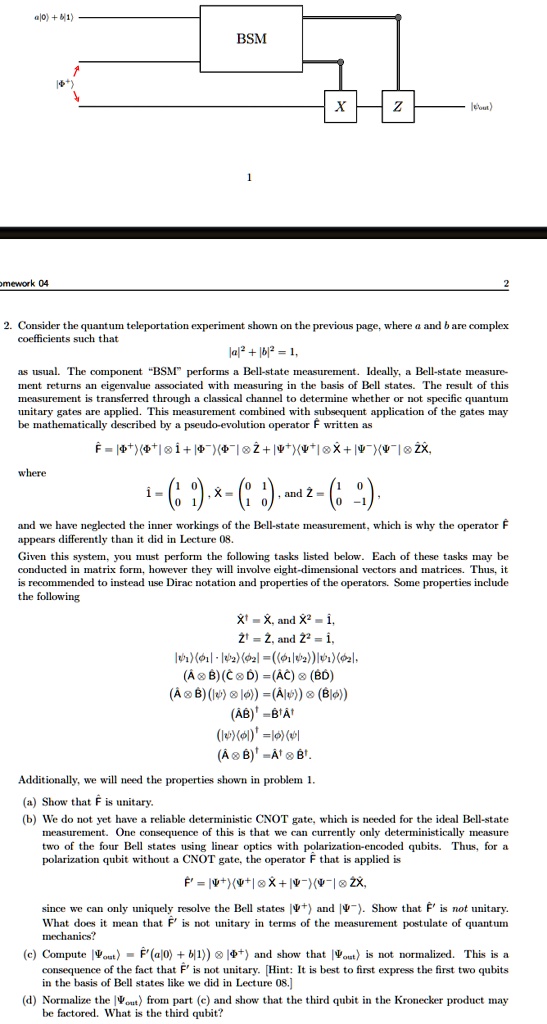
Consider the quantum teleportation experiment shown on the previous page, where a and b are complex
coefficients such that
|a|^(2)+|b|^(2)=1,
as usual. The component "BSM" performs a Bell-state measurement. Ideally, a Bell-state measure-
ment returns an eigenvalue associated with measuring in the basis of Bell states. The result of this
measurement is transferred through a classical channel to determine whether or not specific quantum
unitary gates are applied. This measurement combined with subsequent application of the gates may
be mathematically described by a pseudo-evolution operator hat(F) written as
hat(F)=|Phi ^(+):
where
hat(1)=([1,0],[0,1]),hat(x)=([0,1],[1,0]), and hat(Z)=([1,0],[0,-1]),
and we have neglected the inner workings of the Bell-state measurement, which is why the operator hat(F)
appears differently than it did in Lecture 08.
Given this system, you must perform the following tasks listed below. Each of these tasks may be
conducted in matrix form, however they will involve eight-dimensional vectors and matrices. Thus, it
is recommended to instead use Dirac notation and properties of the operators. Some properties include
the following
hat(x)^(†)=hat(x), and hat(x)^(2)=hat(1),
hat(Z)^(†)=hat(Z), and hat(Z)^(2)=hat(1),
|psi _(1):
Additionally, we will need the properties shown in problem 1.
(a) Show that hat(F) is unitary.
(b) We do not yet have a reliable deterministic CNOT gate, which is needed for the ideal Bell-state
measurement. One consequence of this is that we can currently only deterministically measure
two of the four Bell states using linear optics with polarization-encoded qubits. Thus, for a
polarization qubit without a CNOT gate, the operator hat(F) that is applied is
hat(F)^(')=|Psi ^(+):
since we can only uniquely resolve the Bell states |Psi ^(+):and |Psi ^(-):. Show that hat(F)^(') is not unitary.
What does it mean that hat(F)^(') is not unitary in terms of the measurement postulate of quantum
mechanics?
(c) Compute |Psi _(out ):and show that |Psi _(out ): is not normalized. This is a
consequence of the fact that hat(F)^(') is not unitary. [Hint: It is best to first express the first two qubits
in the basis of Bell states like we did in Lecture 08.]
(d) Normalize the |Psi _(out ): from part (c) and show that the third qubit in the Kronecker product may
be factored. What is the third qubit?
(1|9 + (0)0
BSM
(eout)
2. Consider the quantum teleportation experiment shown on the previous page, where and b are complex coefficients such that |2+[b2=1,
as usual. The component BSM performs a Bell-state measurement. Ideally, a Bell-state measure- ment returns an eigenvalue associated with measuring in the basis of Bell states. The result of this measurement is transferred through a classical channel to determine whether or not specific quantum unitary gates are applied. This measurement combined with subsequent application of the gates may be mathematically described by a pseudo-evolution operator F written as
F=++|i+|Z+|++|X+|ZX
where
i-.x-imd-
and we have neglected the inner workings of the Bell-state measurement, which is why the operator F appears differently than it did in Lecture 08. Given this system, you must perform the following tasks listed below. Each of these tasks may be conducted in matrix form, however they will involve eight-dimensional vectors and matrices. Thus, it is recommended to instead use Dirac notation and properties of the operators. Some properties include the following
X=X,and2=i Zt =Z,and 22=i
|/1122=(12/2|2/12| (AB(C D)=(AC) (BD) (ABl))=(A|(B| AB=BA
AB=AB+. Additionally, we will need the properties shown in problem 1. a) Show that F is unitary. (b) We do not yet have a reliable deterministic CNOT gate, which is needed for the ideal Bell-state measurement. One consequence of this is that we can currently only deterministically measure two of the four Bell states using linear optics with polarization-encoded qubits. Thus, for a polarization qubit without a CNOT gate, the operator F that is applied is =+(+|X+|2X
since we can only uniquely resolve the Bell states |+) and |). Show that F is not unitary. What does it mean that F' is not unitary in terms of the measurement postulate of quantum mechanics? c Compute |out= F(|0 + b|1)+ and show that |out) is not normalized. This is a consequence of the fact that F is not unitary. [Hint: It is best to first express the first two qubits in the basis of Bell states like we did in Lecture 08.] (d) Normalize the |out) from part (c) and show that the third qubit in the Kronecker product may be factored. What is the third qubit?