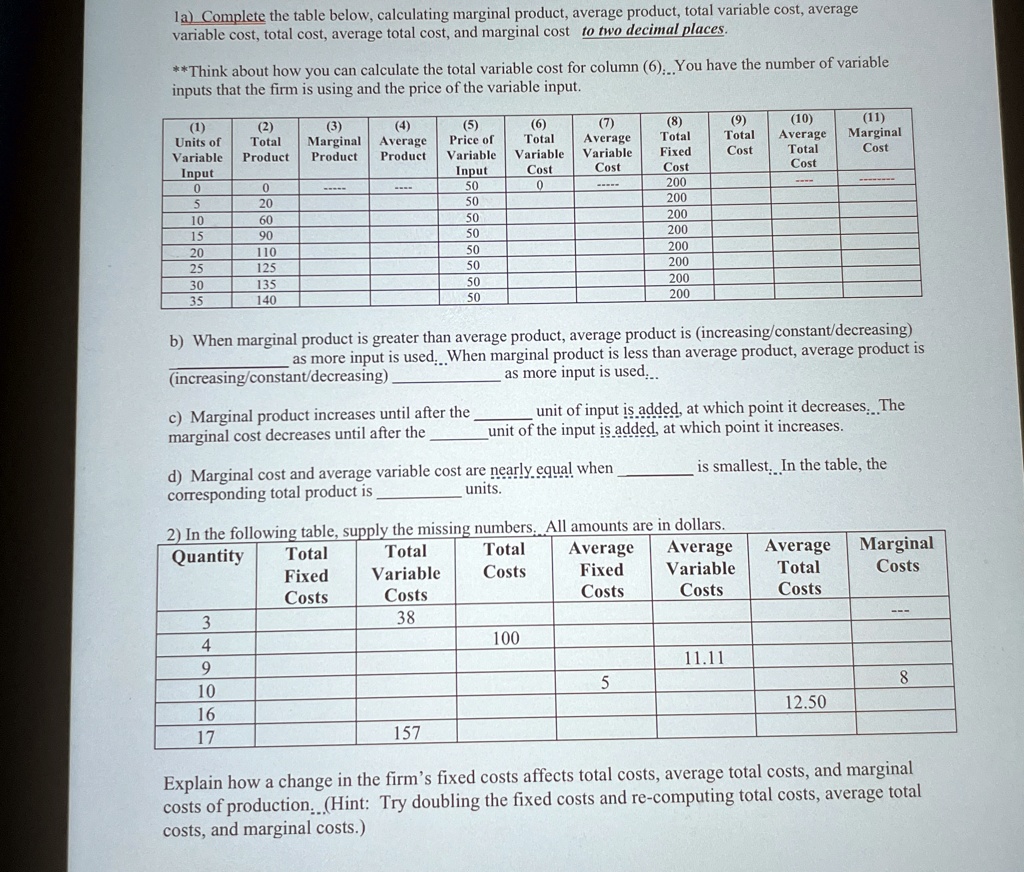
1a) Complete the table below, calculating marginal product, average product, total variable cost, average
variable cost, total cost, average total cost, and marginal cost to two decimal places.
**Think about how you can calculate the total variable cost for column (6). You have the number of variable
inputs that the firm is using and the price of the variable input.
(3)
(4)
Marginal Average
Product Product
(1)
Units of
Variable
(2)
Total
Product
Input
0
0
5
20
10
60
15
90
20
110
25
125
30
135
35
140
(5)
Price of
Variable
(6)
(7)
(8)
(9)
(10)
(11)
Total
Average
Total
Total
Average
Marginal
Variable Variable
Fixed
Cost
Total
Cost
Input
Cost
Cost
Cost
Cost
50
0
200
50
200
50
200
50
200
50
200
50
200
50
200
50
200
b) When marginal product is greater than average product, average product is (increasing/constant/decreasing)
as more input is used. When marginal product is less than average product, average product is
(increasing/constant/decreasing)
as more input is used...
c) Marginal product increases until after the
unit of input is added, at which point it decreases. The
marginal cost decreases until after the
unit of the input is added, at which point it increases.
d) Marginal cost and average variable cost are nearly equal when
corresponding total product is
is smallest. In the table, the
units.
2) In the following table, supply the missing numbers. All amounts are in dollars.
Quantity
Total
Total
Fixed
Variable
Total
Costs
Average Average Average Marginal
Costs
Costs
Fixed
Costs
Variable
Total
Costs
Costs
Costs
3
38
4
100
11.11
9
10
5
8
12.50
16
17
157
Explain how a change in the firm's fixed costs affects total costs, average total costs, and marginal
costs of production. (Hint: Try doubling the fixed costs and re-computing total costs, average total
costs, and marginal costs.)