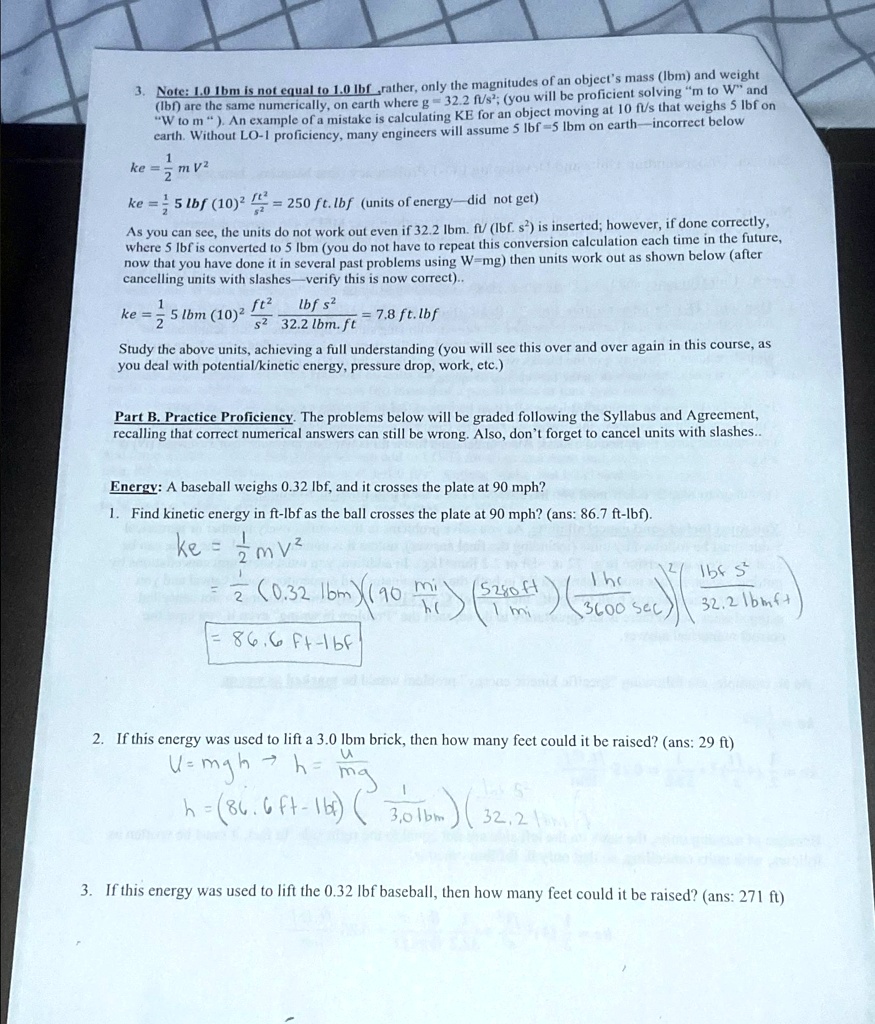
ke = 5lbm(10)^2 = 250 ft.lbf (units of energy - did not get). As you can see, the units do not work out even if 32.2 lbm. f/(lbf.s) is inserted; however, if done correctly, now that you have done it in several past problems using W=mg, then units work out as shown below (after canceling units with slashes - verify this is now correct).
ke = (1/2)5lbm(10)^2(ft^2)/(s^2)(lbf.s^2)/(32.2lbm.ft) = 7.8 ft.lbf. Study the above units, achieving a full understanding (you will see this over and over again in this course, as you deal with potential/kinetic energy, pressure drop, work, etc.).
Part B. Practice Proficiency. The problems below will be graded following the Syllabus and Agreement, recalling that correct numerical answers can still be wrong. Also, don't forget to cancel units with slashes.
Energy: A baseball weighs 0.32 lbf, and it crosses the plate at 90 mph.
1. Find kinetic energy in ft-lbf as the ball crosses the plate at 90 mph (ans: 86.7 ft-lbf).
ke = (1/2)(0.32lbm)((90(mi)/(hi))((5280ft)/(1mi))((1hc)/(3600sec)))^2((1lbf.s^2)/(32.2lbm.ft)).
If this energy was used to lift a 3.0 lbm brick, then how many feet could it be raised? (ans: 29 ft).
h = (86.6ft-lbf)/(3.01lbm)(32.2).
If this energy was used to lift the 0.32 lbf baseball, then how many feet could it be raised? (ans: 271 ft).