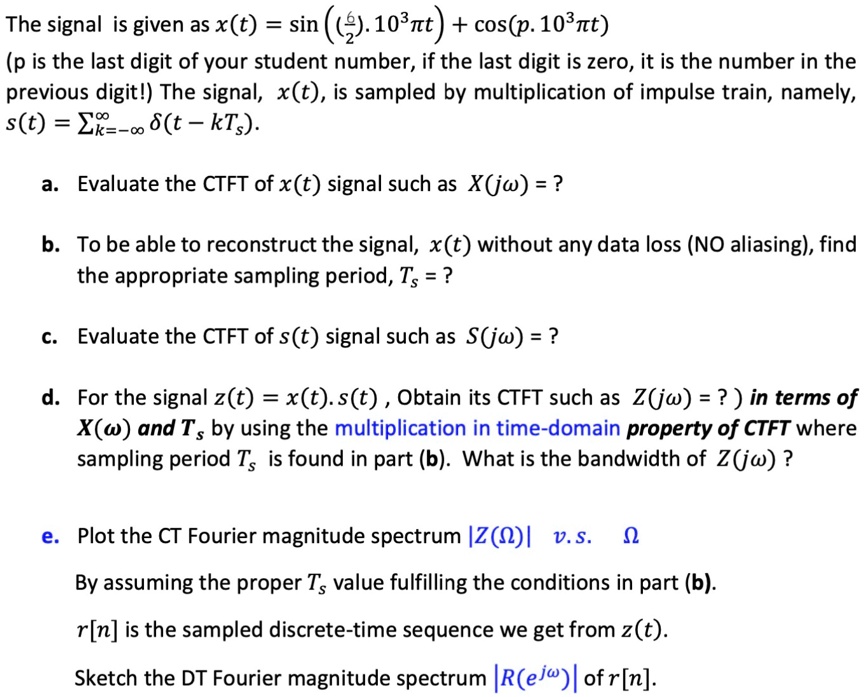
The signal is given as $x(t) = \sin\left(\frac{p}{2}.10^3\pi t\right) + \cos(p.10^3\pi t)$
(p is the last digit of your student number, if the last digit is zero, it is the number in the
previous digit!) The signal, $x(t)$, is sampled by multiplication of impulse train, namely,
$s(t) = \sum_{k=-\infty}^{\infty}\delta(t - kT_s)$.
a. Evaluate the CTFT of $x(t)$ signal such as $X(j\omega) = ?$
b. To be able to reconstruct the signal, $x(t)$ without any data loss (NO aliasing), find
the appropriate sampling period, $T_s = ?$
c. Evaluate the CTFT of $s(t)$ signal such as $S(j\omega) = ?$
d. For the signal $z(t) = x(t).s(t)$, Obtain its CTFT such as $Z(j\omega) = ?)$ in terms of
$X(\omega)$ and $T_s$ by using the multiplication in time-domain property of CTFT where
sampling period $T_s$ is found in part (b). What is the bandwidth of $Z(j\omega)$ ?
e. Plot the CT Fourier magnitude spectrum $|Z(\Omega)|$ v.s. $\Omega$
By assuming the proper $T_s$ value fulfilling the conditions in part (b).
$r[n]$ is the sampled discrete-time sequence we get from $z(t)$.
Sketch the DT Fourier magnitude spectrum $|R(e^{j\omega})|$ of $r[n]$.