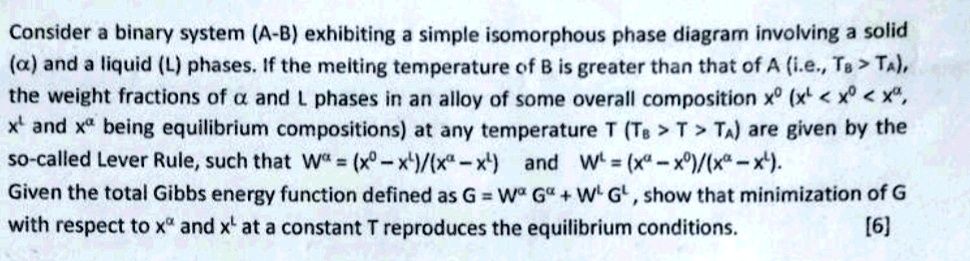
Consider a binary system (A-B) exhibiting a simple isomorphous phase diagram involving a solid\n($\alpha$) and a liquid (L) phases. If the melting temperature of B is greater than that of A (i.e., $T_B > T_A$),\nthe weight fractions of $\alpha$ and L phases in an alloy of some overall composition $x^0$ ($x^l < x^0 < x^\alpha$,\n$x^l$ and $x^\alpha$ being equilibrium compositions) at any temperature T ($T_B > T > T_A$) are given by the\nso-called Lever Rule, such that $W^\alpha = (x^0 - x^l)/(x^\alpha - x^l)$ and $W^l = (x^\alpha - x^0)/(x^\alpha - x^l)$.\nGiven the total Gibbs energy function defined as $G = W^\alpha G^\alpha + W^l G^l$, show that minimization of G\nwith respect to $x^\alpha$ and $x^l$ at a constant T reproduces the equilibrium conditions.\n[6]