Problem 1: Optimal management and the market (the first question in last year's exam)
Just as in the problem from our lecture, a social planner wants to maximize intertemporal welfare in continuous time, while discounting at rate $\rho$. She faces a problem: Natural gas extraction $y$ leads to utility in each generation, i.e. $u(y)$ with $u'(y) > 0$, but with decreasing marginal utility ($u''(y) < 0$). However, the total initial stock of natural gas, $S_0$, is finite. The social planner is uncertain how to allocate the resource over time. (Please use the simple non-renewable resource model as in the lecture.)
a) Which is the correct method to use for constrained intertemporal maximization in continuous time, such as the one given here?
b) Write down the equation for the stock dynamics in this model.
c) Please derive the Hotelling rule for this problem, and give an interpretation of the Hotelling rule.
d) How would you expect the optimal extraction of the resource to change if the social discount rate $\rho$ were a bit lower?
e) An empirical researcher tells you that they can't find that the Hotelling rule holds in practice. Outline one argument of your choice to explain why that might be the case.
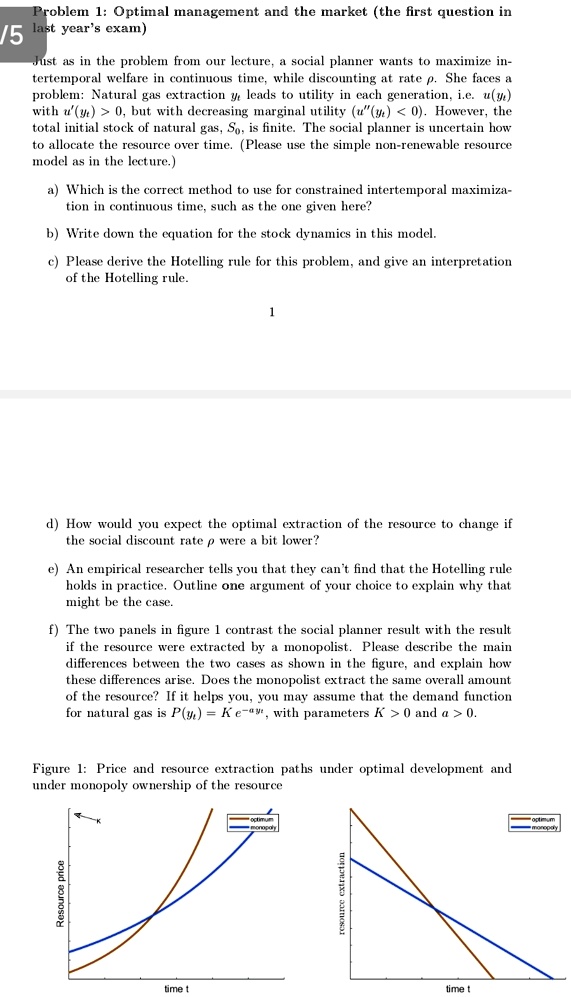
f) The two panels in figure 1 contrast the social planner result with the result if the resource were extracted by a monopolist. Please describe the main differences between the two cases as shown in the figure, and explain how these differences arise. Does the monopolist extract the same overall amount of the resource? If it helps you, you may assume that the demand function for natural gas is $P(y) = Ke^{-ay}$, with parameters $K > 0$ and $a > 0$.
Figure 1: Price and resource extraction paths under optimal development and under monopoly ownership of the resource