QUESTION 4.
Z
A
?
B
y
X
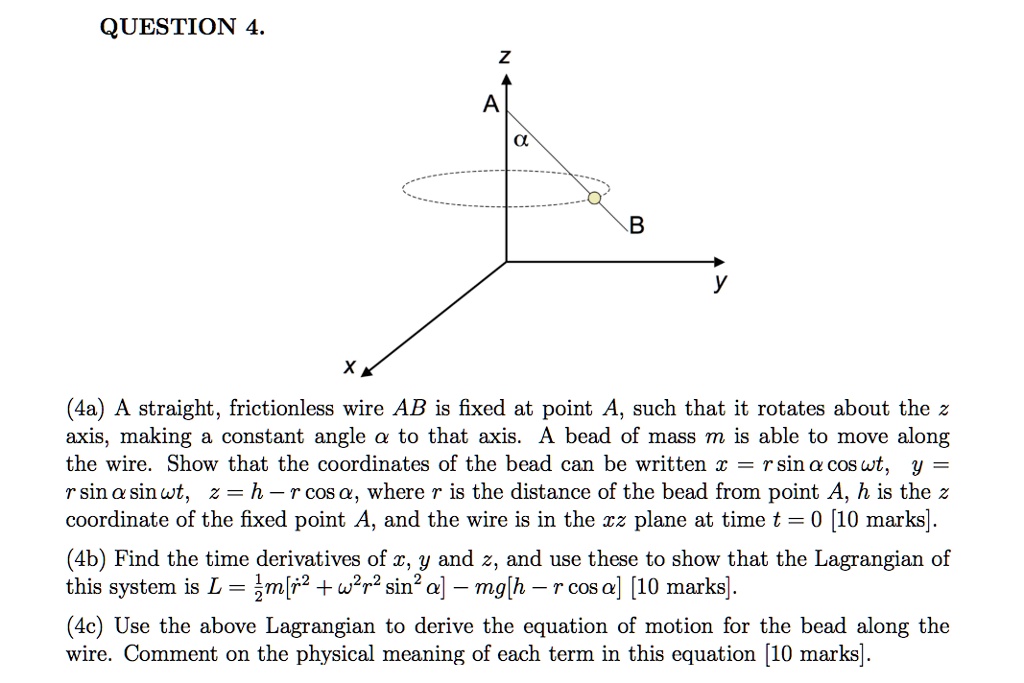
(4a) A straight, frictionless wire AB is fixed at point A, such that it rotates about the z
axis, making a constant angle \(\alpha\) to that axis. A bead of mass m is able to move along
the wire. Show that the coordinates of the bead can be written \(x = r \sin \alpha \cos \omega t\), \(y =
r \sin \alpha \sin \omega t\), \(z = h - r \cos \alpha\), where r is the distance of the bead from point A, h is the z
coordinate of the fixed point A, and the wire is in the xz plane at time \(t = 0\) [10 marks].
(4b) Find the time derivatives of x, y and z, and use these to show that the Lagrangian of
this system is \(L = \frac{1}{2}m[\dot{r}^2 + \omega^2 r^2 \sin^2 \alpha] - mg[h - r \cos \alpha]\) [10 marks].
(4c) Use the above Lagrangian to derive the equation of motion for the bead along the
wire. Comment on the physical meaning of each term in this equation [10 marks].