question (d) and (e) please.
eigenvalues are 6,-1,correspond eigenvecs [2/5 1] transpose; [1 -1] transpose.
diagonal matrix =[[6,0,,],[0,-1,,],[,,ignore these idk how to format,],[,,,]] .
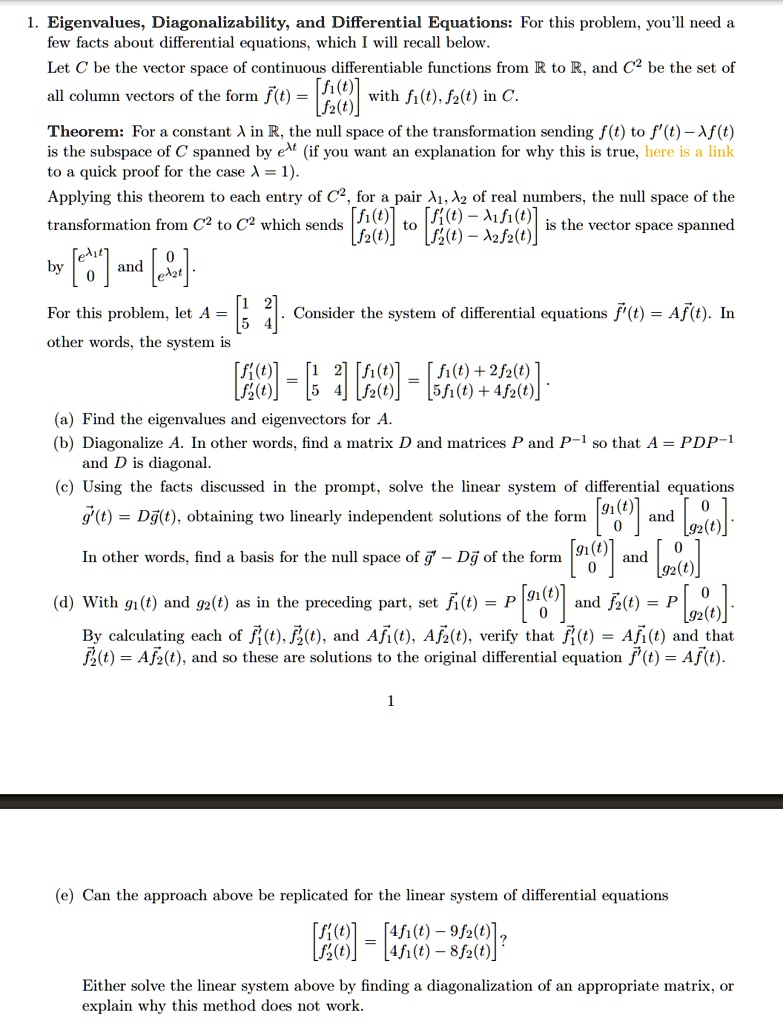
1. Eigenvalues, Diagonalizability, and Differential Equations: For this problem,you'll need a few facts about differential equations, which I will recall below
Let C be the vector space of continuous differentiable functions from R to R, and C2 be the set of [f1t] all column vectors of the form f(t) = with fit,f2t in C. [f2(t)] Theorem: For a constant A in R, the null space of the transformation sending f(t) to f'(t) -Af(t) is the subspace of C spanned by et (if you want an explanation for why this is true, here is a link to a quick proof for the case A =1 Applying this theorem to each entry of C2, for a pair A1, 2 of real numbers, the null space of the transformation from C2 to C2 which sends is the vector space spanned [f2(t)]0[f(t)-X2f2(t)] oy e^1and[
For this problem, let A =
Consider the system of differential equations f'(t) = Af(t). In
other words,the system is
fit]-[12][f1(t]-[f1t+2f2t)] f(t)]=[54][f2t)]=[5f1(t+4f2t)] a Find the eigenvalues and eigenvectors for A. (b) Diagonalize A. In other words, find a matrix D and matrices P and P-1 so that A = PDP-1 and D is diagonal. (c) Using the facts discussed in the prompt, solve the linear system of differential equations g1t 0 g'(t) = Dg(t), obtaining two linearly independent solutions of the form nc [g2t [g1t] 0 In other words, find a basis for the null space of q - Dg of the form and [g2t)]
and f2(t)=P [g2(t)] By calculating each of fit),f(t), and Afit), Af2(t), verify that f(t) = Afit) and that f2(t) = Af2(t), and so these are solutions to the original differential equation f'(t) = Af(t).
1
(e Can the approach above be replicated for the linear system of differential equations
[fit]-[4f1t)-9f2t] f2(t)]=[4f1(t)-8f2t)]
Either solve the linear system above by finding a diagonalization of an appropriate matrix, or explain why this method does not work.