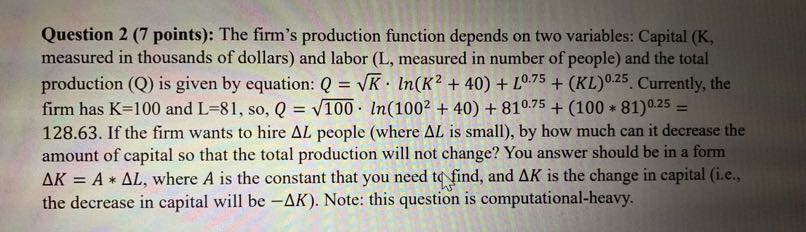
Question 2 (7 points): The firm's production function depends on two variables: Capital ( K , measured in thousands of dollars) and labor ( L , measured in number of people) and the total production \( (\mathrm{Q}) \) is given by equation: \( Q=\sqrt{K} \cdot \ln \left(K^{2}+40\right)+L^{0.75}+(K L)^{0.25} \). Currently, the firm has \( K=100 \) and \( L=81 \), so, \( Q=\sqrt{100} \cdot \ln \left(100^{2}+40\right)+81^{0.75}+(100 * 81)^{0.25}= \) 128.63. If the firm wants to hire \( \Delta L \) people (where \( \Delta L \) is small), by how much can it decrease the amount of capital so that the total production will not change? You answer should be in a form \( \Delta K=A * \Delta L \), where \( A \) is the constant that you need to find, and \( \Delta K \) is the change in capital (i.e., the decrease in capital will be \( -\Delta K \) ). Note: this question is computational-heavy.