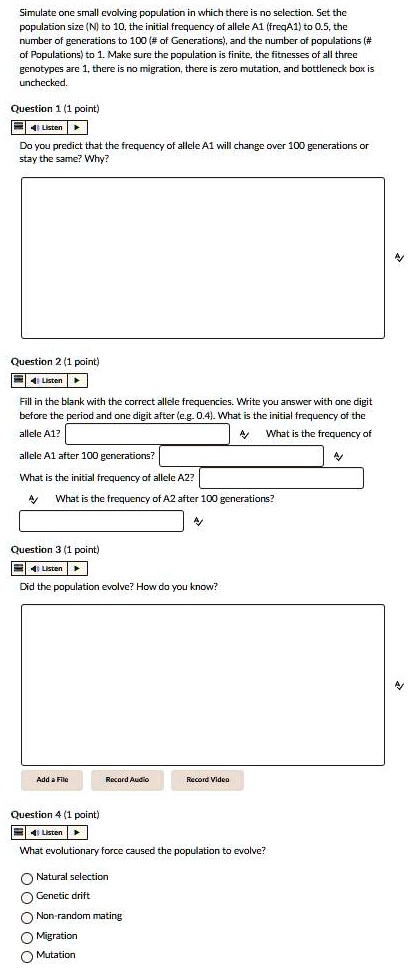
Simulate one small evolving population in which there is no selection. Set the
population size (N) to 10, the initial frequency of allele A1 (freqA1) to 0.5, the
number of generations to 100 (# of Generations), and the number of populations (#
of Populations) to 1. Make sure the population is finite, the fitnesses of all three
genotypes are 1, there is no migration, there is zero mutation, and bottleneck box is
unchecked.
Question 1 (1 point)
Listen
Do you predict that the frequency of allele A1 will change over 100 generations or
stay the same? Why?
Question 2 (1 point)
Listen
Fill in the blank with the correct allele frequencies. Write you answer with one digit
before the period and one digit after (e.g. 0.4). What is the initial frequency of the
allele A1?
allele A1 after 100 generations?
What is the initial frequency of allele A2?
What is the frequency of
A
A
What is the frequency of A2 after 100 generations?
A
Question 3 (1 point)
Listen
Did the population evolve? How do you know?
Add a File
Record Audio
Record Video
Question 4 (1 point)
Listen
What evolutionary force caused the population to evolve?
Natural selection
Genetic drift
Non-random mating
Migration
Mutation
A
A