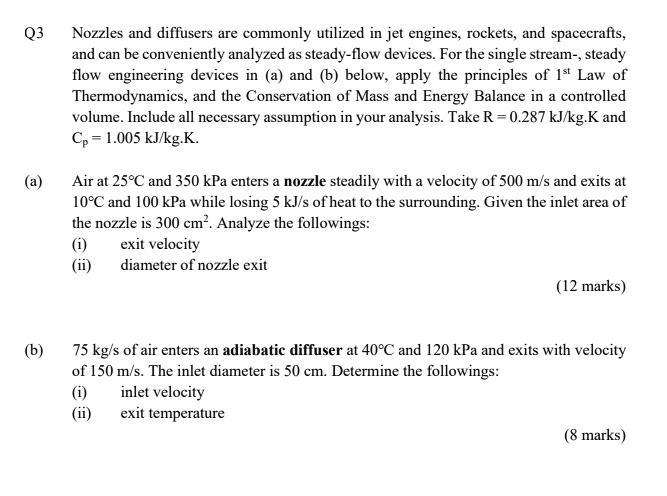
Q3
Nozzles and diffusers are commonly utilized in jet engines, rockets, and spacecrafts,
and can be conveniently analyzed as steady-flow devices. For the single stream-, steady
flow engineering devices in (a) and (b) below, apply the principles of 1st Law of
Thermodynamics, and the Conservation of Mass and Energy Balance in a controlled
volume. Include all necessary assumption in your analysis. Take R = 0.287 kJ/kg.K and
$C_p$ = 1.005 kJ/kg.K.
(a)
Air at 25°C and 350 kPa enters a nozzle steadily with a velocity of 500 m/s and exits at
10°C and 100 kPa while losing 5 kJ/s of heat to the surrounding. Given the inlet area of
the nozzle is 300 $cm^2$. Analyze the followings:
(i)
exit velocity
(ii)
diameter of nozzle exit
(12 marks)
(b)
75 kg/s of air enters an adiabatic diffuser at 40°C and 120 kPa and exits with velocity
of 150 m/s. The inlet diameter is 50 cm. Determine the followings:
(i)
inlet velocity
(ii)
exit temperature
(8 marks)