I.
FUNDAMENTALS ON ELECTROMAGNETICS
To specify a vector at a particular location and time, both its magnitude and direction must be
defined. In three-dimensional space, this requires three values, which vary depending on the
chosen coordinate system. When converting a vector from one coordinate system to another, these
values will change. Vector calculus plays a fascinating and essential role in mathematics, with
significant applications in electromagnetics that underpin wireless communication.
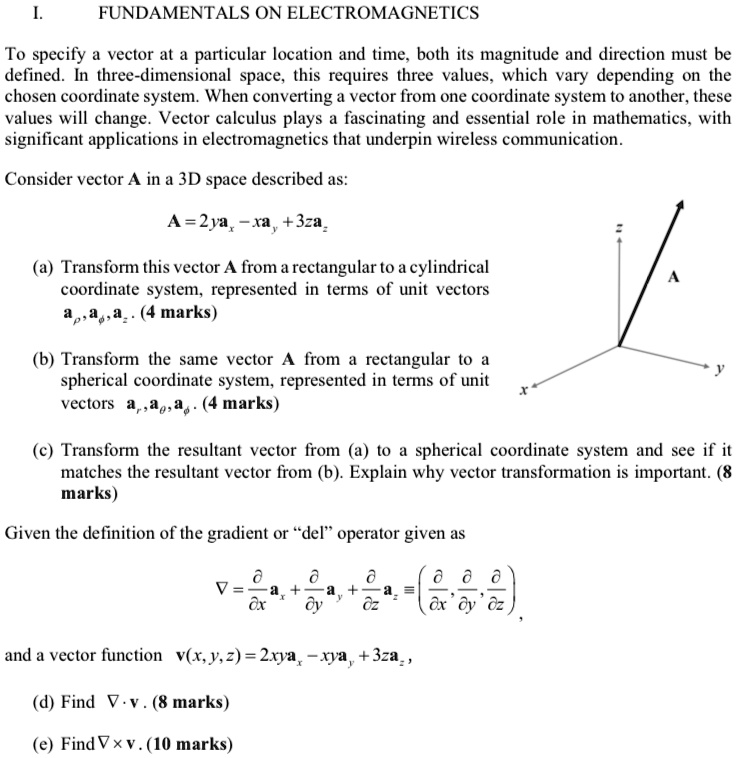
Consider vector A in a 3D space described as:
A = 2ya$_x$ - xa$_y$ + 3za$_z$
(a) Transform this vector A from a rectangular to a cylindrical
coordinate system, represented in terms of unit vectors
a$_r$, a$_\theta$, a$_z$. (4 marks)
(b) Transform the same vector A from a rectangular to a
spherical coordinate system, represented in terms of unit
vectors a$_r$, a$_\theta$, a$_\phi$. (4 marks)
(c) Transform the resultant vector from (a) to a spherical coordinate system and see if it
matches the resultant vector from (b). Explain why vector transformation is important. (8
marks)
Given the definition of the gradient or \"del\" operator given as
$\nabla = \frac{\partial}{\partial x}a_x + \frac{\partial}{\partial y}a_y + \frac{\partial}{\partial z}a_z = \begin{pmatrix}\frac{\partial}{\partial x}, \frac{\partial}{\partial y}, \frac{\partial}{\partial z}\end{pmatrix}$
and a vector function V(x, y, z) = 2xya$_x$ - xya$_y$ + 3za$_z$,
(d) Find $\nabla \cdot$ V. (8 marks)
(e) Find $\nabla \times$ V. (10 marks)