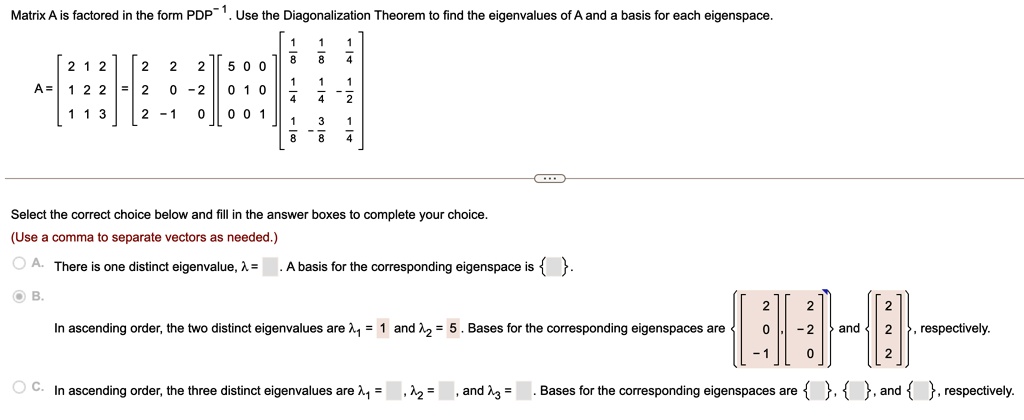
Matrix A is factored in the form $PDP^{-1}$. Use the Diagonalization Theorem to find the eigenvalues of A and a basis for each eigenspace.\\
$A = \begin{bmatrix} 2 & 1 & 2 \\ 1 & 2 & 2 \\ 1 & 1 & 3 \end{bmatrix} = \begin{bmatrix} 2 & 2 & 2 \\ 2 & 0 & -2 \\ 2 & -1 & 0 \end{bmatrix} \begin{bmatrix} 5 & 0 & 0 \\ 0 & 1 & 0 \\ 0 & 0 & 1 \end{bmatrix} \begin{bmatrix} \frac{1}{8} & \frac{1}{8} & \frac{1}{4} \\ \frac{1}{4} & \frac{1}{4} & -\frac{1}{2} \\ \frac{1}{8} & -\frac{3}{8} & \frac{1}{4} \end{bmatrix}$\\Select the correct choice below and fill in the answer boxes to complete your choice.\
(Use a comma to separate vectors as needed.)\\A. There is one distinct eigenvalue, $\lambda = $ . A basis for the corresponding eigenspace is {$ $}.\\B.\
In ascending order, the two distinct eigenvalues are $\lambda_1 = 1$ and $\lambda_2 = 5$. Bases for the corresponding eigenspaces are $\begin{Bmatrix} \begin{bmatrix} 2 \\ 0 \\ -1 \end{bmatrix}, \begin{bmatrix} 2 \\ -2 \\ 0 \end{bmatrix} \end{Bmatrix}$ and $\begin{Bmatrix} \begin{bmatrix} 2 \\ 2 \\ 2 \end{bmatrix} \end{Bmatrix}$, respectively.\
C. In ascending order, the three distinct eigenvalues are $\lambda_1 = $, $\lambda_2 = $, and $\lambda_3 = $. Bases for the corresponding eigenspaces are {$ $}, {$ $}, and {$ $}, respectively.