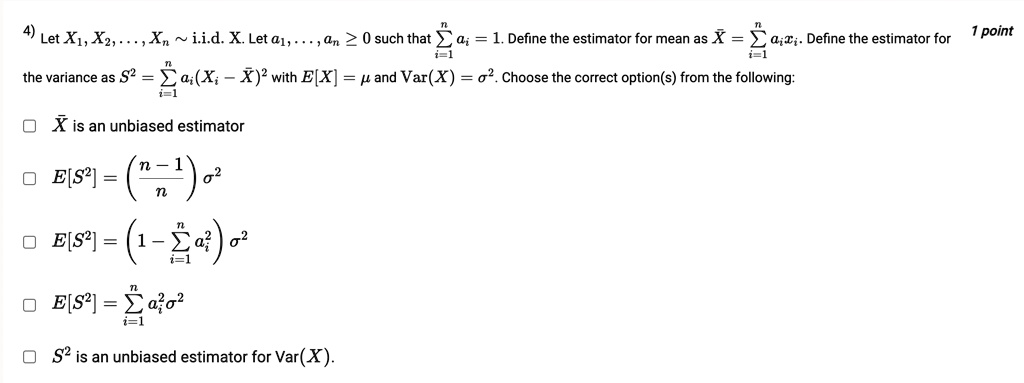
4) Let $X_1, X_2, \dots, X_n \sim \text{i.i.d.} X$. Let $a_1, \dots, a_n \ge 0$ such that $\sum_{i=1}^n a_i = 1$. Define the estimator for mean as $\bar{X} = \sum_{i=1}^n a_i x_i$. Define the estimator for the variance as $S^2 = \sum_{i=1}^n a_i (X_i - \bar{X})^2$ with $E[X] = \mu$ and $Var(X) = \sigma^2$. Choose the correct option(s) from the following:
$\bar{X}$ is an unbiased estimator
$E[S^2] = \left(\frac{n-1}{n}\right)\sigma^2$
$E[S^2] = \left(1 - \sum_{i=1}^n a_i^2\right)\sigma^2$
$E[S^2] = \sum_{i=1}^n a_i^2 \sigma^2$
$S^2$ is an unbiased estimator for $Var(X)$.