QUESTION 4:
20 marks
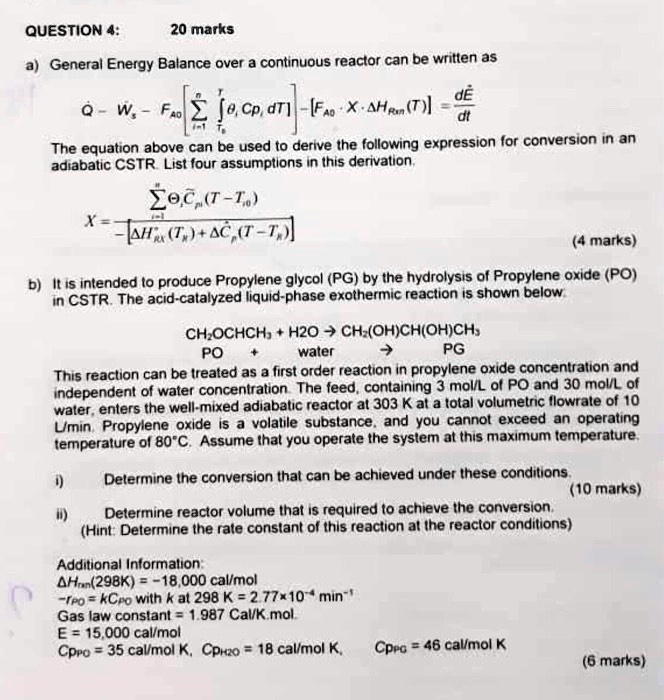
a) The general energy balance over a continuous reactor can be written as:
∑(in) - ∑(out) + ∑(generation) = ∑(accumulation)
The equation above can be used to derive the following expression for conversion in an adiabatic CSTR. List four assumptions in this derivation. (4 marks)
b) It is intended to produce Propylene glycol (PG) by the hydrolysis of Propylene oxide (PO) in a CSTR. The acid-catalyzed liquid-phase exothermic reaction is shown below:
CHOCHCH + H2O → CHOHCH(OHCH) + PO + water → PG
This reaction can be treated as a first-order reaction in propylene oxide concentration and independent of water concentration. The feed, containing 3 mol/L of PO and 30 mol/L of water, enters the well-mixed adiabatic reactor at 303 K at a total volumetric flow rate of 10 L/min. Propylene oxide is a volatile substance, and you cannot exceed an operating temperature of 80°C. Assume that you operate the system at this maximum temperature.
i) Determine the conversion that can be achieved under these conditions. (10 marks)
ii) Determine the reactor volume that is required to achieve the conversion. Hint: Determine the rate constant of this reaction at the reactor conditions. (6 marks)
Additional Information:
ΔH°(298K) = -18.000 cal/mol
-rPo = kCpo, with k at 298K = 2.77x10^(-6) min^(-1)
Gas law constant = 1.987 Cal/K.mol
E = 15.000 cal/mol
Cppo = 35 cal/mol.K
CpHzo = 18 cal/mol.K
Cppo = 46 cal/mol.K